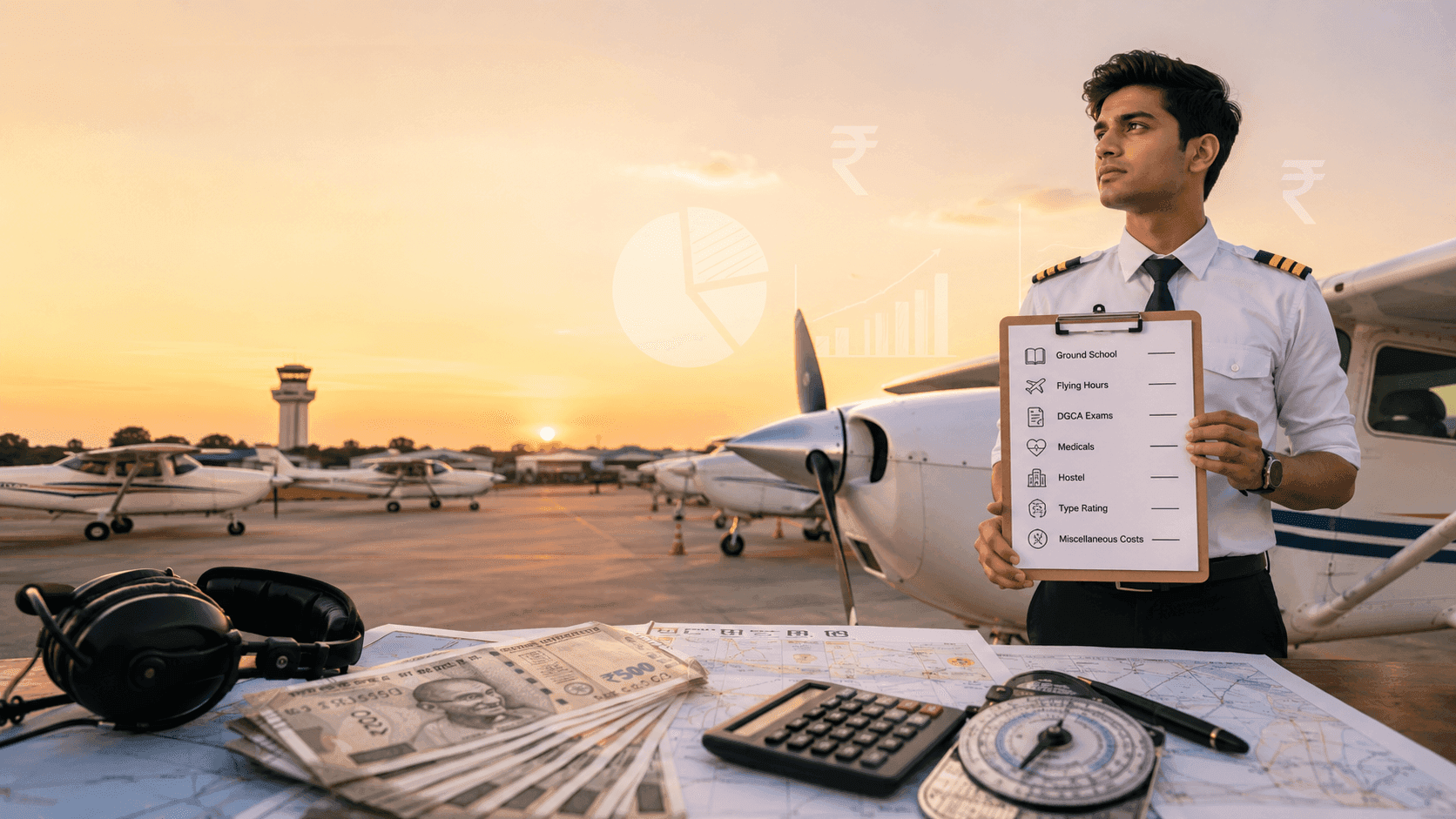

Short answer: a DGCA Commercial Pilot Licence costs ₹45 lakh to ₹75 lakh all-in during 2026. Budget ₹55 lakh as a working number. A type rating, if you add one, is a further ₹15–30 lakh.
The spread is not vagueness. It is the difference between a government flying club charging ₹9,000 an hour and a private FTO charging well over double that — for the same 200 hours.
Figures verified against official institute rate cards and DGCA published fees in July 2026. Flying rates are fuel-linked and change — always confirm current pricing directly with the institute.
| Component | Realistic 2026 cost |
|---|---|
| Ground school (5 DGCA papers) | ₹1.1 – ₹4 lakh |
| Flying training, 200 hours | ₹20 – ₹50 lakh |
| Simulator / FNPT hours | ₹65,000 – ₹2 lakh |
| DGCA exams, RTR(A), licence issue | ₹40,000 – ₹1.5 lakh |
| Class 1 & Class 2 medicals | ₹25,000 – ₹50,000 |
| Admission, membership, security deposits | ₹60,000 – ₹2.5 lakh |
| Headset, books, uniform, logbook | ₹40,000 – ₹2 lakh |
| Living costs, 18–24 months | ₹3 – ₹6 lakh |
| Extra flying hours beyond 200 | ₹2 – ₹10 lakh |
| All-in total | ₹45 – ₹75 lakh |
| Type rating (A320 / B737), optional | + ₹15 – ₹30 lakh |
Why our figure is lower than most: many sites quote ₹80 lakh to ₹1 crore. Those totals usually fold a type rating into the CPL number. A type rating is a separate, post-CPL purchase, and airlines increasingly sponsor or finance it. Keeping the two apart gives you an honest CPL budget.
🎯 Planning your pilot training budget? Talk to our aviation career experts — completely free.
Why every website gives you a different number
Search this and you will get ₹35 lakh from one page and ₹1 crore from another.
Almost every result is published by someone with money riding on the answer. Flying schools quote their own package. Education lenders quote high, because a bigger number is a bigger loan. Aggregator blogs copy whichever figure they found first and never revisit it.
We found a live example while researching this article. One widely-cited 2026 guide lists IGRUA's CPL course at ₹55,00,000. IGRUA's own website states the cost of the course is ₹45 lakh — a ₹10 lakh error sitting on a page that ranks at the top of Google.
Apano Aviation does not operate a flying training organisation and does not sell flying hours. Every figure below is either lifted from an institution's own published rate card, from DGCA's published fee schedule, or clearly labelled as a market range. Where we could not verify something, we have said so rather than repeat it.
Full CPL cost breakdown for 2026
1. Ground school — ₹1.1 to ₹4 lakh
Covers the five DGCA theory subjects — Air Navigation, Meteorology, Air Regulations, Technical General and Technical Specific — plus RTR(A) preparation.
The spread reflects delivery mode. Madhya Pradesh Flying Club's published brochure prices ground classes at around ₹1.1 lakh. Established private institutes in Delhi and Mumbai charge several times that for in-person programmes.
Cost lever: clearing your DGCA papers before joining an FTO is the cheapest optimisation available. It removes dependence on expensive FTO-affiliated ground school and lets you fly from day one.
2. Flying training, 200 hours — ₹20 to ₹50 lakh
This is the bulk of your total, and where the range genuinely lives. DGCA requires a minimum of 200 hours total flight time for a CPL.
Here are verified published hourly rates from two government institutions:
| Institution | Aircraft | Published rate per hour |
|---|---|---|
| Haryana Institute of Civil Aviation (HICA) | Cessna 152 | ₹9,000 |
| Haryana Institute of Civil Aviation (HICA) | Cessna 172-R | ₹10,000 |
| Madhya Pradesh Flying Club (MPFC) | Single-engine | ₹18,000 |
| Madhya Pradesh Flying Club (MPFC) | Multi-engine | ₹45,000 |
HICA rates from the Civil Aviation Department, Government of Haryana fee structure (last updated 30 October 2025). MPFC rates from the club's own published rate calculation (May 2025).
Private DGCA-approved FTOs generally price single-engine time above the MPFC level, with multi-engine time higher again. Those are Apano's own market observations from working with institutes, not published figures — treat them as indicative and ask any FTO for its current rate card in writing.
Do the arithmetic yourself. 185 hours at HICA's ₹9,000 is ₹16.65 lakh of aircraft time. The same 185 hours at ₹18,000 is ₹33.3 lakh. That single variable — the hourly rate — moves your bill by more than ₹16 lakh before anything else is counted.
This is why the per-hour rate matters more than the headline package price. Always ask for the rate, not just the total.
3. Simulator and FNPT — ₹65,000 to ₹2 lakh
Instrument flight simulator and Flight Navigation Procedures Trainer hours are mandatory, and DGCA permits limited simulator credit toward instrument time.
MPFC's published card gives a useful benchmark: 10 hours single-engine simulator at ₹3,000 an hour, plus 10 hours multi-engine at ₹3,500 — ₹65,000 in total.
4. DGCA exams, RTR(A) and licence issue — ₹40,000 to ₹1.5 lakh
DGCA's published examination fee is ₹2,500 per paper for regular scheduled sessions and ₹5,000 per paper for the Online On-Demand Examination (OLODE), as listed on the DGCA Pariksha portal.
That distinction matters and most guides miss it. OLODE costs double but lets you sit a paper when you are ready rather than waiting for a scheduled window. If a single delayed paper would stall your flying by three months, the extra ₹2,500 is cheaper than the living costs of waiting.
Add skill test fees, RTR(A), and licence issuance. MPFC bundles FRTOL, SPL, RT, DGCA fees, ELP, medical and CPL issue into an approximate ₹60,000 line item on its published card — a reasonable planning figure.
The real variable is re-attempts. Every failed paper is another fee, another exam window, and another month of living costs.
5. Class 1 and Class 2 medical — ₹25,000 to ₹50,000
You need a Class 2 medical to begin training and a valid Class 1 Medical Certificate before DGCA will issue your CPL. Cost varies by whether you use a DGCA-empanelled examiner or an IAF Boarding Centre, and whether any finding requires follow-up testing. Indicative range — verify with your chosen examination centre.
Do this first. It is the cheapest item on this list and the only one that can end your career before it starts. Discovering a disqualifying condition after paying lakhs in course fees is entirely avoidable.
6. Admission charges, membership and deposits — ₹60,000 to ₹2.5 lakh
An overlooked category, and the published figures show why:
- IGRUA: admission charges ₹50,000 (non-refundable), plus commitment money of ₹2,00,000 (non-refundable but adjustable against training fee)
- HICA: admission fee ₹20,000 (non-refundable), flying security ₹50,000 (non-refundable)
- MPFC: membership fee ₹40,500 at admission
7. Equipment and materials — ₹40,000 to ₹2 lakh
IGRUA publishes ₹2,00,000 for uniform, training material, navigation computer and headphones. That is a well-equipped end of the range; a headset, books, charts, uniform and logbook can be assembled for considerably less.
8. Living costs — ₹3 to ₹6 lakh
The line most aspirants forget.
India's FTOs operate largely from smaller airfields where accommodation is rarely bundled. IGRUA publishes boarding and lodging at approximately ₹15,000 per month. HICA charges ₹200 per day per occupant where hostel facilities are used, and notes that boarding and lodging arrangements are otherwise the student's own responsibility.
Across an 18–24 month training window, that is a genuine ₹3–6 lakh.
Three verified rate cards, compared
IGRUA (Indira Gandhi Rashtriya Uran Akademi)
India's premier government academy, under the Ministry of Civil Aviation. Ab-initio to CPL including instrument rating and multi-engine endorsement.
| Item | Published figure |
|---|---|
| Course cost | ₹45,00,000 |
| Uniform, training material, nav computer, headphones | ₹2,00,000 |
| Admission charges (non-refundable) | ₹50,000 |
| Commitment money (adjustable against fee) | ₹2,00,000 |
| Boarding and lodging | ~₹15,000 per month |
| B.Sc (Aviation) option, optional | ₹20,000 per year, 3 years |
| Indicative all-in over ~24 months | ≈ ₹51 lakh |
Source: IGRUA official Selection Procedure page, last updated 11 May 2026.
MPFC (Madhya Pradesh Flying Club)
A state-run non-profit at Indore and Bhopal, and the most transparently itemised card we found anywhere.
| Item | Rate | Amount |
|---|---|---|
| Membership fee | — | ₹40,500 |
| 185 hours single-engine | ₹18,000/hr | ₹33,30,000 |
| Instructional flying, ~75 hours | ₹600/hr | ₹45,000 |
| 15 hours multi-engine | ₹45,000/hr | ₹6,75,000 |
| Simulator, 10 hrs single-engine | ₹3,000/hr | ₹30,000 |
| Simulator, 10 hrs multi-engine | ₹3,500/hr | ₹35,000 |
| Other (FRTOL, SPL, RT, DGCA, ELP, medical, CPL issue) | — | ₹60,000 |
| Published total | ₹42,15,500 |
Paid as ₹40,500 at admission, five instalments of ₹8 lakh tied to flying-hour milestones, and a balancing payment of approximately ₹1,75,000.
MPFC's own card carries an important caveat: the estimate is based on current flying rates, and if the flying rate changes, the rate ruling at the time of training applies. Fuel-linked repricing is disclosed on the document itself — a level of honesty worth looking for elsewhere.
Note that this total excludes ground school and living costs.
Source: MPFC published rate calculation, May 2025.
HICA (Haryana Institute of Civil Aviation)
A Government of Haryana undertaking operating clubs at Karnal, Hisar and Pinjore. HICA publishes hourly rates rather than a package total — so the comparison below is aircraft time only.
| Item | Published figure |
|---|---|
| Cessna 152, per hour | ₹9,000 |
| Cessna 172-R, per hour | ₹10,000 |
| Admission fee (non-refundable) | ₹20,000 |
| Flying security (non-refundable) | ₹50,000 |
| Night flying surcharge | ₹2,000/hr, minimum 2 hours |
| Hostel, where used | ₹200 per day per occupant |
Rates are identical for General, female and SC/ST candidates, with SC/ST training sponsored by the Ministry of Social Justice and Empowerment.
Source: Civil Aviation Department, Government of Haryana, last updated 30 October 2025.
The finding that matters. HICA's published ₹9,000–10,000 an hour is roughly half MPFC's ₹18,000, and well under half typical private FTO rates. Over 200 hours that is a difference of ₹16 lakh or more — larger than every other line item on this page combined. Before anything else, ask what the hourly rate is.
The trade-off is real: HICA has a small fleet and limited approved seats, so availability and completion pace need checking carefully. A low rate at a school that cannot fly you is not a saving.
Pilot training cost in India per month
Spread across a realistic 20-month programme, a ₹55 lakh CPL averages about ₹2.75 lakh per month — but the spend is nowhere near evenly distributed.
| Phase | Typical duration | Monthly outflow |
|---|---|---|
| Medical, computer number, onboarding | 1–2 months | ₹30,000 – ₹60,000 |
| Ground school + DGCA exams | 4–6 months | ₹40,000 – ₹1.2 lakh |
| Flying / hour building | 10–14 months | ₹2.5 – ₹4.5 lakh |
| Skill test + licence processing | 1–2 months | ₹40,000 – ₹80,000 |
MPFC's instalment schedule illustrates the pattern precisely: ₹40,500 at admission, then five ₹8 lakh instalments triggered at 20, 75, 100 and 150 flying hours. The money follows the flying, not the calendar.
Plan your loan disbursement around the flying phase, not the enrolment date.
Pilot course fees by licence type
| Licence / rating | Typical fee range in India |
|---|---|
| Student Pilot Licence (SPL) | ₹50,000 – ₹1 lakh |
| Private Pilot Licence (PPL), aeroplane | ₹4 – ₹14 lakh |
| Commercial Pilot Licence (CPL), aeroplane | ₹45 – ₹75 lakh all-in |
| Multi-engine endorsement | ₹4 – ₹8 lakh |
| Instrument Rating | Usually bundled within CPL |
| Type rating (A320 / B737) | ₹15 – ₹30 lakh |
The PPL range is wide for the same reason as the CPL: HICA charges the same ₹9,000–10,000 an hour for PPL training as for CPL, and a PPL requires a minimum of 40 hours. At those rates, 40 hours is under ₹4 lakh of aircraft time.
A PPL is not a cheaper route to a CPL — it is a separate licence for private, non-remunerative flying. Hours logged do count toward your 200, so the paths overlap, but if your goal is an airline job, go straight for the CPL.
Government vs private flying schools
The persistent myth is that government clubs are dramatically cheaper. The verified data says: it depends entirely on which government club.
IGRUA publishes ₹45 lakh, which sits inside the private-sector range. MPFC publishes ₹42.15 lakh. HICA's hourly rates imply a substantially lower flying bill than either.
| Government / state-linked | Private DGCA-approved FTO | |
|---|---|---|
| Hourly rate | ₹9,000 – ₹18,000 (published) | Generally higher; varies with fleet availability |
| Fee transparency | Strong — published, itemised cards | Mixed; inclusions often unclear |
| Seat availability | Limited, competitive entrance | Generally open, rolling intake |
| Fuel repricing | Disclosed on the card (MPFC) | Often undisclosed until billed |
| Best for | Students who want a fixed, verifiable framework | Students optimising for timeline or location |
What government institutions reliably offer is a published rate card you can hold them to. The trade-off is competitive entrance and limited seats — IGRUA runs a national written test, pilot aptitude test and interview through TCS.
Cheapest pilot training in India — and what "lowest fees" actually costs you
The lowest genuine CPL totals in India sit around ₹42–48 lakh, achievable at a government club with an efficient training run and no repeated papers. MPFC's published ₹42.15 lakh, plus ground school and living costs, is a real-world floor.
Anything advertised meaningfully below that is usually one of four things:
- A partial quote — flying hours only, with no ground school, exams, medicals or living costs.
- A minimum-hours assumption — priced at exactly 200 hours, when most students need more.
- A rate without a surcharge policy — fuel repricing applied per hour, rarely in the headline.
- An FTO with a fleet problem — the cheapest hourly rate in the country is worthless if there are three serviceable aircraft for eighty students.
A useful reframe: the cheapest FTO is the one that finishes you fastest. An institute charging more per hour but completing you six months earlier saves living costs and gets you earning sooner.
Ask two questions before signing: what is your student-to-aircraft ratio, and what percentage of last year's cohort completed within 24 months?
⚠️ Verify approval status before you pay. DGCA has suspended FTOs mid-session. Check current approval standing and confirm there is no ongoing enforcement action against any organisation you are considering.
Cadet pilot programmes
| Route | Total cost | What you get |
|---|---|---|
| Independent CPL | ₹45 – ₹75 lakh | Licence only; job search is yours |
| CPL + self-funded type rating | ₹60 lakh – ₹1 crore | Licence plus type rating, no placement |
| Airline cadet programme | ₹85 lakh – ₹1.2 crore+ | Ground school, CPL, ME/IR, type rating, airline operational training |
The premium buys structure and a defined pathway, not a guarantee.
📖 Cadet Pilot Program in India 2026 — IndiGo & Air India Guide
India vs abroad
Foreign schools quote attractive package prices. Most comparisons stop there — and that omission is expensive, because a foreign licence is not a DGCA licence.
United States. ATP Flight School publishes $123,995 from zero experience, or $90,995 starting with a private pilot certificate. Both include training and certification through commercial pilot with flight instructor certificates. ATP raised these prices on 6 March 2026. (ATP Flight School published pricing)
Note this is not a like-for-like comparison with a DGCA CPL. ATP's programme includes flight instructor certificates, because the US pathway requires 1,500 hours for airline work and most graduates instruct to build them. India's CPL requires 200. You are buying different products.
Conversion is the missing line. Returning to India means clearing DGCA theory papers, an RTR(A), a skill test on an Indian-registered aircraft, and a document-verification process that routinely takes months. Budget for the conversion itself plus several further months of living costs.
Add currency risk. A 5% rupee move against the dollar on a $124,000 package is roughly ₹5 lakh, entirely outside your control.
Training abroad can still make sense for faster hour building and weather reliability. Decide on landed cost, not brochure price.
Hidden costs that break budgets
| Hidden cost | Typical impact | Why it happens |
|---|---|---|
| Extra flying hours | ₹2 – ₹10 lakh | Most students need more than 200 hours. At ₹18,000/hr, 25 extra hours is ₹4.5 lakh. |
| Fuel-linked repricing | Varies | MPFC discloses it on the card. Many do not. |
| Training delays | ₹15,000 – ₹25,000 per month | Weather, unserviceable aircraft, instructor shortage. Each idle month is pure living cost. |
| DGCA re-attempts | ₹2,500 – ₹1 lakh | ₹2,500 per regular paper, ₹5,000 per OLODE paper, plus waiting time. |
| Night flying surcharge | ₹2,000/hr at HICA | Published, but easy to miss when budgeting. |
| Non-refundable deposits | ₹60,000 – ₹2.5 lakh | Admission charges, flying security, commitment money. Gone if you withdraw. |
The three questions that expose all of it:
- Is fuel repricing included in your quoted hourly rate, or billed separately?
- What is your student-to-aircraft ratio right now?
- What was last year's average completion time?
In writing.
How to fund pilot training in India
Education loans
Major banks and NBFCs lend for DGCA-approved training. IGRUA notes that its DGCA-approved courses are structured so students can avail bank benefits and subsidies.
| Feature | Typical terms |
|---|---|
| Loan amount | Up to ₹1 crore for DGCA-approved programmes |
| Collateral | Usually required above ₹7.5 lakh |
| Moratorium | Course duration + 6–12 months |
| Tenure | 7–15 years |
| Documentation | Admission letter from a DGCA-approved FTO is mandatory |
Terms are indicative and vary by lender — confirm current conditions directly.
Two things people get wrong. The moratorium is not a holiday — most lenders accrue simple interest through it, which capitalises into your principal. And disburse in tranches tied to training phases, not as a lump sum. MPFC's milestone-based instalment schedule is a natural fit for this.
Government support
The clearest verified example: the Ministry of Social Justice and Empowerment sponsors SC/ST candidates for both PPL and CPL training at HICA, confirmed on the Haryana Civil Aviation Department's own fee page.
Several states run aviation-specific loan and subsidy schemes, and IGRUA maintains a financial assistance page covering bank tie-ups.
Specific scholarship amounts under MSJE and the SC Top Class scheme are not reproduced here — the sponsorship is confirmed, but current per-hour entitlements should be checked against the National Scholarship Portal before you rely on them.
Is pilot training worth ₹55 lakh? The payback maths
A newly licensed First Officer in India starts around ₹1–1.5 lakh per month, rising with hours. A wide-body captain at a major carrier can reach ₹15–20 lakh a month.
Model a ₹55 lakh CPL funded by a ₹50 lakh loan at 10% over 10 years — roughly ₹66,000 a month in EMI.
| Career stage | Typical monthly income | EMI as share of income |
|---|---|---|
| Junior First Officer (year 1–2) | ₹1 – ₹1.5 lakh | 44 – 66% |
| First Officer (year 3–5) | ₹2.5 – ₹4 lakh | 17 – 26% |
| Senior First Officer (year 6–8) | ₹5 – ₹8 lakh | 8 – 13% |
| Captain (year 9+) | ₹10 – ₹20 lakh | Under 7% |
Realistic payback: 6–9 years from licence issue, assuming reasonably prompt placement.
The honest caveat: the first two years are tight, and placement is not instant. Many newly licensed pilots wait 6–18 months for a first flying job while the EMI still arrives. Build a 12-month buffer — that buffer, not the training fee, separates aspirants who make it from those who stall.
On demand: Boeing's 2025 Pilot and Technician Outlook projects that India and South Asia will need approximately 45,000 new pilots by 2044, within about 141,000 new aviation professionals overall. Boeing's Commercial Market Outlook forecasts nearly 3,300 new aircraft for the region over the same period.
Be careful with that 141,000 figure — several guides quote it as pilot demand. It is not. It covers pilots, technicians and cabin crew together. The pilot number is 45,000.
Does age affect pilot training cost?
Age does not change the fee. It changes the return.
You need to be 17 to hold an SPL and 18 for a CPL, with 10+2 including Physics and Mathematics. IGRUA's ab-initio intake requires a minimum age of 17 at joining, 10+2 with Maths, Physics and English at 50% per subject (45% for SC/ST/OBC/EWS), and a minimum height of 5 feet 2 inches.
There is no upper age limit for a DGCA CPL, but airline recruitment favours younger candidates and your earning runway shortens with every year you delay.
Your budget checklist
- Budget ₹55 lakh as the working number.
- Add 15% contingency for extra hours and delays.
- Do the Class 1 medical first. Before any other spend.
- Ask for the per-hour rate, not the package total. It is the single biggest variable.
- Clear DGCA papers before joining an FTO.
- Get the fuel repricing policy in writing.
- Check the non-refundable portion — admission, security and commitment money are gone if you withdraw.
- Check current DGCA approval standing for every FTO you shortlist.
- Structure your loan in tranches against training milestones.
- Keep 12 months of living costs in reserve for the post-licence job search.
- Verify every figure directly with the institute. Rates move with fuel.
📞 Want help shortlisting an FTO that fits your budget? Our counsellors can give you an honest comparison based on cost, aircraft availability and completion rates. 👉 Get Free FTO Guidance — No Cost, No Obligation
Frequently Asked Questions
Can I become a pilot with 30 lakhs? Not for a full DGCA CPL, but it is closer than most guides suggest. At HICA's published ₹9,000 an hour, 200 hours is ₹18 lakh of aircraft time — leaving room within ₹30 lakh for ground school, exams and medicals, though not for living costs, multi-engine time or any extra hours. At MPFC's ₹18,000 an hour the same 200 hours is ₹33 lakh before anything else. Realistically, plan for ₹45 lakh minimum.
What is the total cost of pilot training in India? ₹45 lakh to ₹75 lakh for a DGCA CPL, all in. Verified reference points: MPFC publishes ₹42,15,500 for flying, simulator and licensing; IGRUA publishes ₹45,00,000 for the course plus roughly ₹4.5 lakh in equipment, admission and commitment money. Add ground school and living costs to both.
Can I be a pilot in 2 years? Yes. Two years is a realistic CPL timeline if training runs without long gaps. Most students complete in 18–24 months.
Are government flying school fees cheaper than private? It depends which one. IGRUA publishes ₹45 lakh, inside the private range. But HICA publishes ₹9,000–10,000 per flying hour, roughly half MPFC's ₹18,000 and well below typical private rates. What government institutions reliably offer is published, verifiable pricing — with competitive entrance and limited seats as the trade-off.
How much are DGCA exams? ₹2,500 per paper for regular scheduled sessions, ₹5,000 per paper for the Online On-Demand Examination (OLODE). Five theory subjects, plus RTR(A) and licence issuance fees.
Is JEE required to become a pilot? No. JEE has no role. You need 10+2 with Physics and Mathematics, a DGCA Class 1 or 2 medical, and admission to a DGCA-approved FTO. Candidates without Physics and Maths can add them through NIOS.
How much does pilot training cost per month? About ₹2.75 lakh a month averaged across 20 months, concentrated in the flying phase where outflow reaches ₹2.5–4.5 lakh. Early months are far lighter.
Can I get a loan for the full amount? Most major banks lend up to ₹1 crore for DGCA-approved programmes. Collateral is typically required above ₹7.5 lakh, and an admission letter from an approved FTO is mandatory.
Pilot training is a large, structured investment — not an unknowable one. Ask for the hourly rate, read the rate card, and verify every number with the institute before you commit.