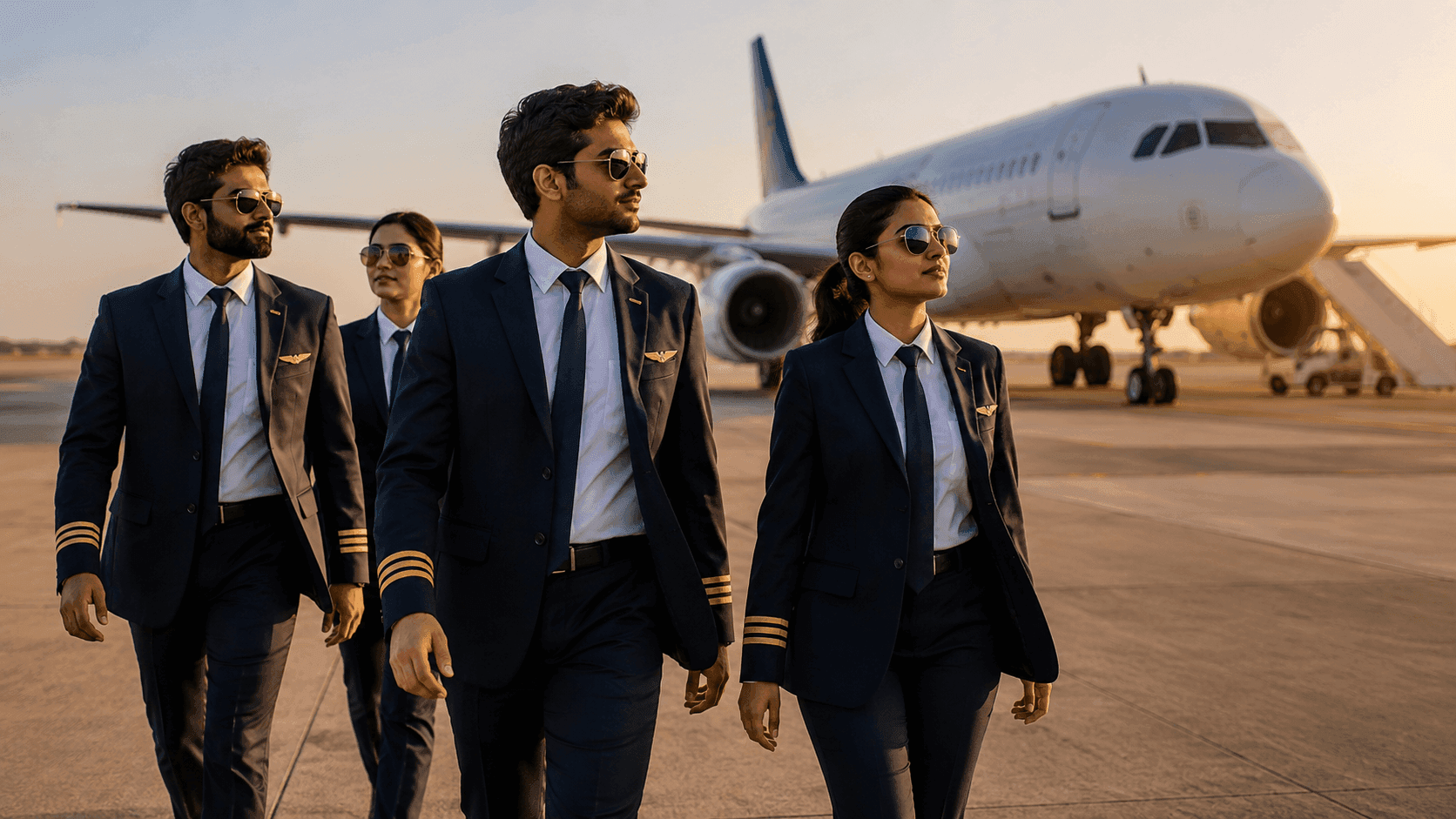

Choosing between an independent CPL and an airline cadet program is one of the most consequential decisions an aspiring pilot makes. You pay more upfront — but you get structured training, an included type rating, and a defined pathway into the cockpit at IndiGo, Air India, or Akasa Air. This guide covers everything: who actually runs these programs, which institutes you can train at, eligibility, fees, the honest truth about the "job guarantee", and a clear verdict on cadet program vs independent CPL for 2026.
🎯 Not sure if a cadet program is right for your profile?
What Is a Cadet Pilot Program?
A Cadet Pilot Program is an airline-run training pathway that takes aspiring pilots from zero flying experience to airline-ready First Officers. Selected candidates undergo structured ground school, flight training, licence issue, aircraft type rating, and airline operational preparation — all monitored by the sponsoring airline and conducted under DGCA regulations.
After successful completion of training and the airline's final checks, cadets join the sponsoring airline as a Junior First Officer (JFO) or First Officer (FO) depending on operational requirements.
"A cadet program is not just about getting a licence — it is about becoming airline-ready from day one. You train on the exact aircraft you will fly, with the SOPs you will use on your first revenue flight."
Who Actually Runs a Cadet Program — The Airline or the Institute?
This is the single most misunderstood point among aspirants, so let's be precise:
The airline owns and runs the cadet program. The flying institute only delivers the training.
Here is how the structure actually works:
- The airline (IndiGo, Air India, Akasa) designs the program, conducts the selection, signs the Letter of Intent (LOI), sets training standards, and inducts successful cadets into its fleet.
- The Flight Training Organisation (FTO) — like CAE, Chimes, or Dunes Aviation — is the airline's contracted training partner. It conducts your ground school and flying hours according to the airline's syllabus. You cannot walk into an FTO and "join a cadet program" directly; you must first clear the airline's selection process.
- No institute can independently offer an airline cadet program. An FTO can only run cadet batches for airlines it has an official partnership agreement with.
⚠️ Red flag to watch for: If a flying school advertises its own "cadet program with 100% job guarantee" without naming an official airline partnership, treat it with extreme caution. Verify the FTO's name on the airline's official cadet program page before paying anything.
Which Airlines Run Cadet Pilot Programs in India in 2026?
Three carriers currently run active cadet pilot programs in India:
| Airline | Program Name | Fleet You Train For | Status (July 2026) |
|---|---|---|---|
| IndiGo | IndiGo Cadet Pilot Program | Airbus A320 family / ATR | Active — India's largest cadet intake, running since 2006 |
| Air India | Fly High – Air India Cadet Pilot Program | Fleet type not officially published | Active — launched 2024 under Tata ownership |
| Akasa Air | Akasa SkyCadet Programme | Boeing 737 MAX | New — launched 12 June 2026; Batch 1 applications closed, next intake expected |
| SpiceJet | SpiceJet Cadet Pilot Program | Boeing 737 | ⚠️ Dormant — no recent intakes; exercise caution given the airline's financial situation |
📖 Related: Pilot Salary in India 2026: Complete Guide
IndiGo Cadet Pilot Program
India's largest airline runs the country's biggest and oldest cadet program (since 2006 — IndiGo press release), and plans to source the bulk of its future pilots through it. Official details: goindigo.in — How to Become a Pilot.
Eligibility (IndiGo):
- 10+2 with minimum 51% individually in Physics, Mathematics and English (NIOS accepted with 51% in each required subject)
- Minimum age 18 years; upper age limit varies by FTO partner (typically 30–40 — check the specific FTO's intake notice)
- Indian national or OCI card holder with a valid passport
- DGCA Class 2 Medical to apply; Class 1 Medical mandatory before LOI signing
- Fluent written and spoken English
Note the common myth: IndiGo does not require 60% in PCM. The requirement is 51% in Physics, Mathematics and English individually — Chemistry is not assessed.
IndiGo FTO Partners (2026): IndiGo currently works with nine Flight Training Organisations — four in India and five abroad:
| FTO Partner | Location | Notes |
|---|---|---|
| CAE (NFTI) | Gondia, Maharashtra | Combined DGCA/FAA-aligned program; most popular domestic option — official program page |
| Chimes Aviation Academy | Dhana & Neemuch, Madhya Pradesh | Domestic training and DGCA conversion; also delivers the Giving Wings to Fly ATR program |
| Garuda Aviation Academy | Gurugram, Haryana | Newest domestic partner (added 2024) |
| Marigold Aviation | India | 21-month program: 15 months ground school/CPL-MEIR, 4 months licence conversion, 2 months A320 type rating; IndiGo's 9th FTO partner — official announcement (added Oct 2024) |
| Skyborne Airline Academy | Vero Beach, Florida, USA | FAA CPL then DGCA conversion; trains up to 100 IndiGo cadets a year |
| L3Harris Flight Academy | Florida, USA | Large-scale ab-initio infrastructure |
| NZICPA | Whanganui, New Zealand | FAA/DGCA-aligned; registrations via Flightrule Aviation |
| Flight Training Adelaide (FTA) | Adelaide, Australia | Strong Asia-Pacific airline pedigree |
| Insight Aviation / 43 Air School | Port Alfred, South Africa | Insight is the selection partner; flying at 43 Air School |
Cost: approximately ₹85 lakh – ₹1.3 crore depending on the FTO, training country, and inclusions. The fee covers ground school, CPL flight training, multi-engine and instrument ratings, DGCA licence conversion (for overseas cadets), Airbus A320 type rating, and airline operational training. Duration is typically 18–22 months, extendable by visa, weather, or licensing delays.
Outcome: Successful completion of all phases and IndiGo's final checks leads to induction as a Junior First Officer on the Airbus A320.
Air India Cadet Pilot Program
Launched in 2024 after the Tata takeover as Fly High – Air India Cadet Pilot Program, this is the flag carrier's structured cadet pathway. Official portal: cadetpilot.airindia.com.
Eligibility (Air India):
- 10+2 with minimum 60% in each of English, Mathematics and Physics (NIOS accepted)
- Age 18 to 30 years
- Indian national or OCI with valid passport
- DGCA Class 1 Medical required before flight training
- Good command of written and spoken English
Training structure: CPL training is delivered at the Air India Flying Training Academy (AIFTA) at Amravati, Maharashtra, or at one of two US partner schools — AeroGuard Flight Training Center (cadets based at Phoenix, Arizona) and L3Harris Flight Academy (Sanford, Florida). The full program takes approximately 24 months including type rating.
The Air India differentiator: Air India has not published a standard fleet-type list for cadet type ratings at its Gurugram training academy — assignment is expected to follow fleet requirement (potentially including A320neo, Boeing 787, or Boeing 777), but confirm the current position on the official cadet portal before assuming a specific aircraft type.
Financing: Air India has a financing tie-up with Tata Capital, though cadets are free to use any lender.
Cost: approximately ₹60 lakh – ₹1.3 crore depending on the training partner (Air India does not publish fees publicly; third-party estimates put the L3Harris pathway around ₹1.07 crore — verify exact figures on the official portal before committing).
Akasa Air SkyCadet Programme — New in 2026
Launched on 12 June 2026, the Akasa SkyCadet Programme is India's newest airline cadet pathway, training pilots for Akasa's all–Boeing 737 MAX fleet.
Eligibility (Akasa):
- Indian citizens only, with a valid passport
- Minimum 18 years at application; maximum 40 years at enrolment — the most age-friendly cadet program in India
- 10+2 with Physics, Mathematics and English; English proficiency required
- DGCA medical fitness as per standard commercial pilot requirements; clean background
Training structure — three phases: Ground School (DGCA subjects), CPL flight training in India, and Boeing 737 MAX type rating with full-flight simulator training. Akasa's indicative timelines are roughly 4 months ground school, 18 months flight training, and 2 months type rating.
Training partners: Dunes Aviation Academy (Bhavnagar, Gujarat and Bhilwara, Rajasthan) and Skynex Aero Pvt. Ltd. (Jalgaon, Maharashtra). For Gujarat-based aspirants, Dunes at Bhavnagar makes this the first major airline cadet program with a training base inside the state.
Fees: Akasa does not publish fees publicly — the fee structure is shared inside the official application form. Be cautious of any third party quoting a "confirmed" figure; industry estimates place it broadly in the ₹90 lakh – ₹1.3 crore range, but only the application form is authoritative.
Status: Batch 1 applications closed in June 2026. Given Akasa's confirmed fleet expansion plans, further intakes are expected — monitor the official page and apply only through Akasa's own portal.
Giving Wings to Fly: IndiGo's Scholarship for Women Pilots
A genuinely different opportunity launched in June 2026: Giving Wings to Fly is a fully supported pilot training program for young women from economically weaker backgrounds — a CSR initiative supported by IndiGoReach (IndiGo's CSR arm), implemented by BharatCares (SMEC Trust), with training delivered at Chimes Aviation Academy, a DGCA-approved FTO. Official details: bharatcares.org/giving-wings-to-fly.
What it covers: approximately 20 months of training including Commercial Pilot Licence (CPL) and ATR Type Rating, plus accommodation and meals during training, mentorship from aviation professionals, and structured career-pathway exposure.
Eligibility:
- Indian female citizen, aged 18–35 (as of 1 May 2026 for Batch 1)
- 10+2 with English, Physics and Mathematics — minimum 51% in each of the three subjects
- Must belong to an EWS household as per prevailing Government of India guidelines (broadly: annual family income under ₹8 lakh, plus property criteria)
- Valid Indian passport (can be obtained before Phase 3 of selection)
Selection: multi-stage — application screening, aptitude assessments, interviews, and final shortlisting. Applications are accepted exclusively through the official ScholarsBox portal; applications via agents or third-party channels are rejected.
Status: Batch 1 applications closed on 30 June 2026. Eligible candidates should prepare their EWS certificate and documents now and watch the official portal for the next batch announcement.
Does a Cadet Program Guarantee You a Job? The Honest Answer
No — and any source telling you it's a 100% guarantee is misleading you. Here is exactly what you get, and what you don't:
What you actually get: a conditional Letter of Intent (LOI). If you complete every training phase to the airline's standard, pass all DGCA requirements, clear the airline's final simulator and operational checks, and hold a valid Class 1 Medical, the airline inducts you as a Junior First Officer. In practice, the vast majority of cadets who complete training do get inducted — this is why the pathway is valued.
What can break the pathway:
- Performance failure: Airlines monitor every phase. Repeated failed check rides, DGCA exam failures beyond permitted attempts, or unsatisfactory final assessments can lead to warnings or removal from the program — with your money already spent.
- Medical loss: Losing your Class 1 Medical at any stage ends the pathway. Fees paid are generally not recoverable.
- Induction delays: Even successful cadets can wait several months for a joining date depending on fleet deliveries and airline requirements.
- Airline risk: This is India-specific and real. When Jet Airways collapsed in 2019 and Go First in 2023, trained pilots — including cadets — were left holding licences with no cockpit to go to, and some aged past hiring windows while waiting. An LOI is only as strong as the airline behind it. This is a genuine argument for choosing financially strong carriers (IndiGo, Air India) and for scrutinising any program from a stressed airline.
The bond: After induction, airlines typically require cadets to serve a defined period (commonly around 5–7 years, per your training agreement). Leaving early usually triggers repayment of training costs. Read the agreement clause-by-clause before signing.
Bottom line: Call it high-probability job assurance, not a job guarantee. It is far more certain than the independent CPL route — but it is conditional, and the conditions are on you and on the airline's health.
📖 Related: DGCA Class 1 Medical: Requirements & Process
📖 Related: DGCA CPL Exam Pattern & Syllabus 2026
Selection Process: Step by Step
The IndiGo selection is the most commonly referenced benchmark; Air India and Akasa follow a similar multi-stage funnel:
| Stage | What Is Assessed |
|---|---|
| 1. Online Application & Screening | Eligibility verification — marks, age, nationality, documents |
| 2. Written / Aptitude Examination | Mathematics & Physics (10+2 level), logical reasoning, English comprehension |
| 3. Pilot Aptitude Test (ADAPT / CASS type) | Hand–eye coordination, reaction time, multitasking, spatial awareness |
| 4. Group Exercise & Personal Interview | Communication, teamwork, motivation, professional attitude, psychometric profile |
| 5. Medical & Documentation | DGCA Class 1 Medical; LOI signing after clearance |
"The computerised aptitude test is where many otherwise strong candidates stumble. You cannot cram for it the night before — hand–eye coordination and reaction time require consistent practice over months."
Important: most airlines enforce cooling periods after a failed stage (typically 3–6 months) and cap attempts — IndiGo, for example, permanently closes the door after a second unsuccessful aptitude attempt. Prepare before you apply, not after you fail.
Training Structure
Cadet pilot training moves through five sequential phases:
| Phase | Details |
|---|---|
| Ground School (DGCA Subjects) | Air Navigation, Meteorology, Air Regulation, Technical General & Specific, RTR(A) |
| Flight Training | ~200 flying hours at the assigned FTO in India or abroad; leads to CPL issue (plus DGCA conversion if trained overseas) |
| Licensing & Ratings | Commercial Pilot Licence (CPL), Multi-Engine Rating, Instrument Rating |
| Aircraft Type Rating | Airbus A320 (IndiGo), fleet type not officially published (Air India), Boeing 737 MAX (Akasa) |
| Airline Operational Training | Full-flight simulator sessions, SOPs, Multi-Crew Cooperation, line operations |
Cadet Program Fees 2026: What You Actually Pay
| Program | Approximate Cost | What Is Included |
|---|---|---|
| IndiGo Cadet Pilot Program | ₹85 lakh – ₹1.3 crore | Ground school, CPL flight training, ME + IR, DGCA conversion, A320 type rating, airline ops training |
| Air India Cadet Pilot Program | ₹60 lakh – ₹1.3 crore | Ground training, CPL flight training, ME + IR, type rating (fleet not officially published), airline ops training |
| Akasa SkyCadet Programme | Disclosed in application form only (est. ₹90L–₹1.3Cr) | Ground school, CPL training in India, Boeing 737 MAX type rating |
| Independent CPL Route | ₹35 lakh – ₹80 lakh | CPL only — type rating (₹25–35 lakh) and airline entry are separate, self-arranged costs |
Fees vary by FTO and are revised regularly — always verify the current figure on the airline's official page before signing anything. Most partner FTOs facilitate education loans covering 90%+ of costs; also see the Gujarat Government Pilot Training Loan Scheme (up to ₹1.5 crore for eligible Gujarat candidates).
Government FTOs like IGRUA remain the most affordable non-cadet path at roughly ₹30 lakh+ for CPL training — but seats are intensely competitive, and the program includes neither a type rating nor airline placement assurance.
Salary After Completing a Cadet Program
Cadet graduates typically enter as a Junior First Officer and follow the standard airline seniority ladder:
| Position | Experience | Monthly Salary (2026) |
|---|---|---|
| Junior First Officer (JFO) | 0–1 year | ₹1,00,000 – ₹1,50,000 |
| First Officer (FO) | 1–3 years | ₹2,00,000 – ₹3,50,000 |
| Senior First Officer (SFO) | 3–5 years | ₹3,50,000 – ₹4,50,000 |
| Captain (Domestic Narrowbody) | 6–10 years | ₹5,00,000 – ₹10,00,000 |
| Senior / Check Captain | 10+ years | ₹12,00,000 – ₹20,00,000+ |
Figures represent gross monthly CTC including flying allowances. The jump from SFO to Captain — typically at the 6–8 year mark — is the single largest salary leap in a pilot's career. IndiGo states that all cadets are hired as future captains with a four-to-five-year runway to command eligibility.
Honest Verdict: Cadet Pilot Program vs Independent CPL
Here is the assessment we give aspirants in one-on-one counselling — no sugar-coating either side.
Pros of a cadet program:
- Structural certainty: selection → LOI → training → induction. You know your airline before your first flying hour.
- Type rating included — the ₹25–35 lakh cost and the post-CPL "type rating gamble" of the independent route disappear.
- Airline-standard training from day one: you learn your future employer's SOPs, not generic ones.
- Faster to the cockpit: typically 18–24 months versus an often-unpredictable 24–36+ months independently.
- Financing is easier: structured programs with airline backing unlock 90%+ education loans that independent trainees struggle to get.
Cons of a cadet program:
- ₹30–50 lakh more expensive than the independent route, paid upfront, with limited refunds if you wash out.
- Not a guarantee: performance failure, medical loss, or airline distress can break the pathway (see the section above).
- Zero flexibility: you are bonded to one airline for 5–7 years. If a better opportunity appears, exiting is expensive.
- Selection is brutal: aptitude tests filter heavily, with cooling periods and lifetime attempt caps.
- Debt pressure: a ₹1 crore loan on a ₹1–1.5 lakh JFO salary means the first 5–8 years are financially tight.
Pros of the independent CPL:
- Lower entry cost (₹35–80 lakh) — and you can pause, switch FTOs, or stagger spending.
- Full freedom: apply to any airline in India or abroad; no bond until you accept a job.
- Merit route stays open: airlines do run direct First Officer intakes for CPL + type-rated candidates, especially in the current pilot shortage.
Cons of the independent CPL:
- No placement assurance whatsoever. You compete in open recruitment against every other CPL holder.
- The type rating gamble: paying ₹25–35 lakh for a type rating with no job in hand is the single riskiest financial decision in Indian aviation.
- Quality variance: FTO standards vary widely; a poorly chosen school costs time, money, and hours.
Our verdict:
- Choose a cadet program if you can arrange ₹1 crore+ (family funds or loan), you clear the aptitude selection genuinely (not on the third attempt at a weaker program), and your goal is a stable airline career in India. The premium you pay is effectively insurance against the type-rating gamble — and for most aspirants who can afford it, that insurance is worth it.
- Choose the independent CPL if your budget is firmly under ₹80 lakh, you want the option of flying abroad or for multiple carriers, or you're targeting subsidised routes like IGRUA or state loan schemes. It works — but treat the post-CPL job hunt as a project in itself, and do not pay for a type rating until you have realistic airline interest.
- If you are a woman from an EWS household: apply to Giving Wings to Fly before anything else. Fully supported CPL + ATR type rating is an opportunity without parallel in Indian aviation right now.
🎯 Want a personalised cost and ROI projection?
Our aviation career counsellors can map your expected earnings based on your background, budget, and target airline — completely free.
Frequently Asked Questions
Which airlines run cadet pilot programs in India in 2026?
Three airlines run active programs: IndiGo (Airbus A320, since 2006), Air India (Fly High, launched 2024), and Akasa Air (SkyCadet, launched June 2026, Boeing 737 MAX). SpiceJet's program is currently dormant with no recent intakes.
Can an institute give me a cadet program directly?
No. Cadet programs are owned by airlines; institutes (FTOs) only deliver the training under an official partnership. You must clear the airline's selection first. Verify any FTO's partnership claim on the airline's official website.
What is the eligibility for the IndiGo cadet pilot program?
10+2 with minimum 51% individually in Physics, Mathematics and English (not 60%, and Chemistry is not required — NIOS is accepted), minimum age 18, Indian national or OCI, valid passport, and the ability to obtain a DGCA Class 1 Medical before LOI signing.
What is the total cost of a cadet pilot program in India?
Between roughly ₹60 lakh and ₹1.3 crore depending on the airline and FTO. IndiGo ranges ₹85L–₹1.3Cr by partner; Air India runs approximately ₹60L–₹1.3 crore (unofficial estimate — Air India doesn't publish fees); Akasa discloses fees only inside its official application form.
Does a cadet program guarantee a job?
No — it provides a conditional Letter of Intent. Induction depends on completing every training phase to standard, passing the airline's final checks, and holding a valid Class 1 Medical. Most cadets who complete training are inducted, but performance failure, medical loss, or airline financial distress can break the pathway.
Is there a bond after completing a cadet program?
Yes — airlines typically require cadets to serve around 5–7 years after induction as per the training agreement. Leaving early generally requires repayment of training costs. Read your agreement carefully before signing.
Can I apply for a cadet program after 12th grade?
Yes. All three programs accept candidates directly after 10+2 with Physics, Mathematics and English. No prior aviation experience or graduation is required.
What is the Giving Wings to Fly program?
A fully supported pilot training initiative for Indian women aged 18–35 from EWS households, backed by IndiGoReach (IndiGo's CSR arm), implemented by BharatCares, with CPL + ATR Type Rating training at Chimes Aviation Academy — including accommodation, meals, and mentorship. Applications are accepted only via the official ScholarsBox portal. Batch 1 closed on 30 June 2026; watch for the next batch.
What is the age limit for cadet pilot programs?
It varies: Air India accepts 18–30; IndiGo's minimum is 18 with FTO-dependent upper limits (typically 30–40); Akasa is the most flexible at 18 (application) to 40 (enrolment).
How long does a cadet program take?
Typically 18–24 months from program start to airline induction — covering ground school, flight training, licence issue, type rating, and operational training. Visa, weather, and DGCA licensing timelines can extend this.
Ready to assess your cadet program eligibility?
Our aviation career experts can review your academic background, medical fitness, and financial profile — and tell you honestly whether a cadet program or the independent CPL route is your stronger path.