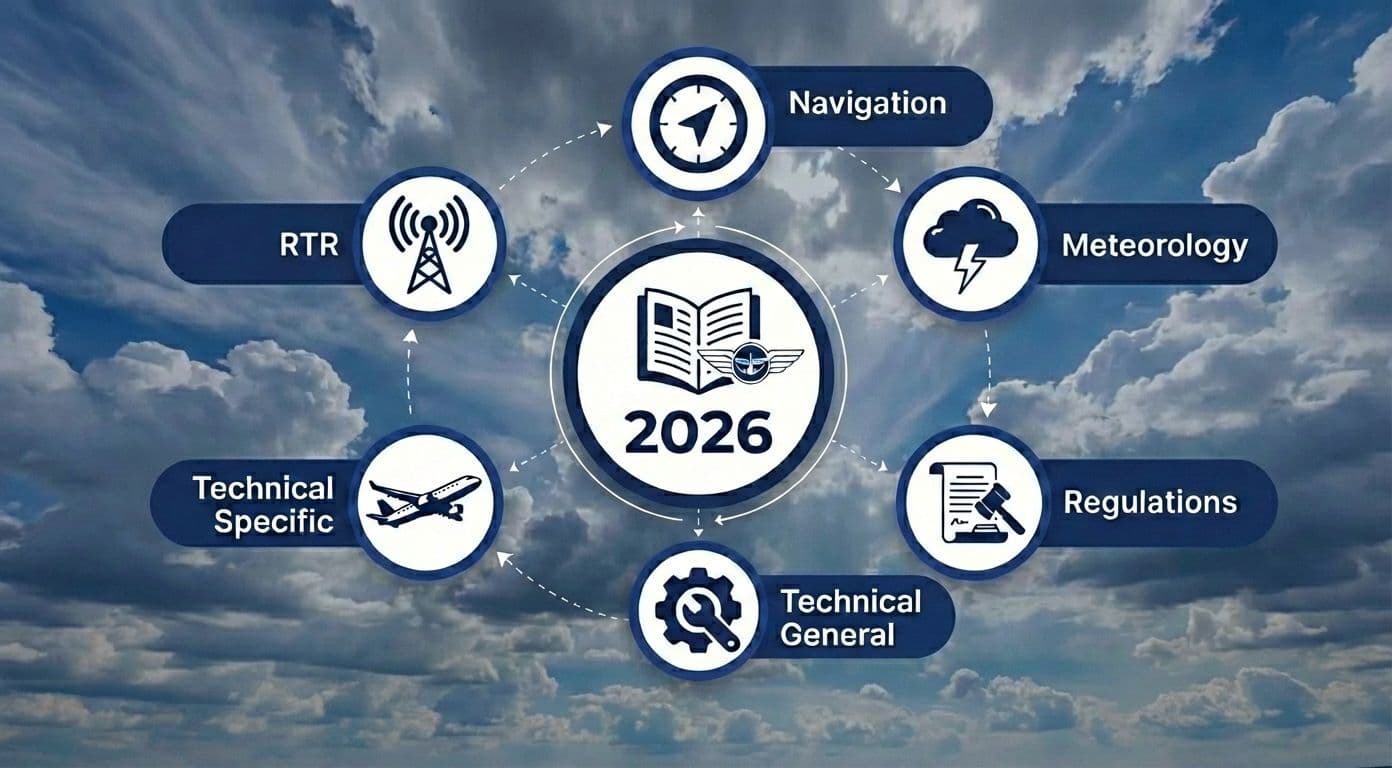


If you're preparing for DGCA CPL exams in 2026, understanding previous year question patterns is your biggest advantage. This comprehensive analysis breaks down exactly what DGCA has been asking, which topics repeat consistently, and where you should focus your preparation time.
The data doesn't lie—certain topics appear in almost every exam session while others rarely show up. Smart candidates use this information to prioritize their study time effectively.
Current DGCA CPL Exam Structure (2026)
Before diving into patterns, here's the exam structure you'll face:
| Subject | Questions | Duration | Pass Marks | Difficulty Level |
|---|---|---|---|---|
| Air Navigation | 100 MCQs | 3 hours | 70/100 | Hardest |
| Technical General | 100 MCQs | 3 hours | 70/100 | Hard |
| Aviation Meteorology | 50 MCQs | 2 hours | 35/50 | Easy-Moderate |
| Air Regulations | 50 MCQs | 2 hours | 35/50 | Moderate |
| Technical Specific | ~50 MCQs | 2 hours | 70% | Easiest |
| RTR(A) | Written + Oral | Variable | Pass both | Moderate |
Key points for 2026:
- All papers require 70% minimum to pass
- No negative marking—attempt every question
- Subject validity is 5 years from passing date
- Exams conducted 4 times annually via Pariksha portal
- Overall first-attempt pass rate: approximately 50%
Major Pattern Changes: What's Different in 2025-2026
DGCA has significantly changed its approach since 2023. Here's what the data shows:
Old Pattern (Pre-2023)
- Questions repeated verbatim from textbooks
- Same numerical values across sessions
- Memory-based approach worked well
- Predictable question banks
New Pattern (2024-2026)
- Scenario-based questions testing application
- Same concepts but with modified values
- FMS, RNAV, GPS problems added to Navigation
- Human Performance & Limitations content increased
- Questions now test "why" not just "what"
Example of pattern shift:
Old style: "What is the maximum drift formula?"
New style: "Aircraft flying at TAS 150 knots encounters 30-knot crosswind from the right. Calculate the drift angle and determine if you'll reach destination fuel-critical."
The formula knowledge is still required, but application matters more now.
Subject-Wise Question Pattern Analysis
1. Air Navigation – The Gatekeeper (Hardest Paper)
Air Navigation has an 80-90% failure rate historically. Here's exactly what gets asked:
Topic Weightage Distribution
| Topic | Weightage | Typical Questions |
|---|---|---|
| Dead Reckoning | 15-18% | 15-18 questions |
| 1-in-60 Rule Applications | 8-10% | 8-10 questions |
| Time Calculations (UTC/LMT/IST) | 8-10% | 8-10 questions |
| Wind Triangle Problems | 10-12% | 10-12 questions |
| Radio Navigation (VOR/DME/ADF) | 12-15% | 12-15 questions |
| FMS/RNAV/GPS (New) | 8-10% | 8-10 questions |
| Map Reading & Projections | 8-10% | 8-10 questions |
| Point of Equal Time/No Return | 5-8% | 5-8 questions |
Formulas That Repeat Every Session
These formulas appear in every single exam—memorize and practice extensively:
1-in-60 Rule:
Track Error = (Distance Off Track × 60) / Distance Flown
Closing Angle = (Distance Off Track × 60) / Distance To Go
Maximum Drift:
Max Drift = (Wind Speed × 60) / TAS
Point of Equal Time (PET):
PET = (Total Distance × Groundspeed Home) / (GS Home + GS Out)
Point of No Return (PNR):
PNR = (Endurance × GS Home × GS Out) / (GS Home + GS Out)
Convergency:
Convergency = D.Long × Sin(Mean Latitude)
Conversion Angle:
Conversion Angle = ½ × Convergency
Common Traps in Navigation Questions
- Magnetic vs True confusion – Remember: "Variation East, Magnetic Least; Variation West, Magnetic Best"
- Wind direction convention – Winds are always FROM direction
- Unit conversions – NM to KM (×1.852), KM to SM (÷1.609)
- Date line crossing – Westward = add day, Eastward = subtract day
Preparation Strategy: Solve 15-20 numerical problems daily. Use E6B flight computer for wind triangle problems.
2. Aviation Meteorology – Easiest to Clear First
Meteorology is 90% theory-based with predictable patterns. Start your CPL journey here.
Topic Weightage Distribution
| Topic | Weightage | Typical Questions |
|---|---|---|
| METAR/TAF Decoding | 15-18% | 8-10 questions |
| Cloud Classification | 12-15% | 6-8 questions |
| Atmospheric Structure | 8-10% | 4-5 questions |
| Pressure Systems | 8-10% | 4-5 questions |
| Indian Monsoon & Climatology | 5-7% | 3-4 questions |
| Fog & Visibility | 6-8% | 3-4 questions |
| Icing & Turbulence | 8-10% | 4-5 questions |
| Fronts & Air Masses | 6-8% | 3-4 questions |
Concepts That Repeat Constantly
Tropopause Heights (appears every exam):
- Equator: ~54,000 ft (16-17 km)
- Mid-latitudes: ~36,000 ft (11 km)
- Poles: ~28,000 ft (8 km)
Standard Lapse Rates:
- Temperature: 2°C per 1,000 ft (or 6.5°C per km)
- Pressure: 1 mb per 30 ft (near sea level)
Fog Types (2-3 questions every session):
- Radiation Fog: Clear nights, light winds, moist air
- Advection Fog: Warm moist air over cold surface
- Upslope Fog: Air rises along terrain
- Frontal Fog: Associated with warm fronts
METAR Decoding Practice Example:
METAR VIDP 100530Z 27008KT 4000 HZ FEW020 SCT100 32/21 Q1008 NOSIG
- VIDP: Delhi Airport
- 100530Z: 10th day, 0530 UTC
- 27008KT: Wind from 270° at 8 knots
- 4000: Visibility 4000 meters
- HZ: Haze
- FEW020: Few clouds at 2000 ft
- SCT100: Scattered at 10,000 ft
- 32/21: Temp 32°C, Dewpoint 21°C
- Q1008: QNH 1008 mb
- NOSIG: No significant change expected
Preparation Strategy: Decode 5 real METARs daily from Indian airports. Use aviationweather.gov for practice.
3. Air Regulations – Memory-Based Scoring
This paper rewards systematic memorization. ICAO Annexes dominate.
Topic Weightage Distribution
| Topic | Weightage | Typical Questions |
|---|---|---|
| ICAO Annexes (1, 2, 6, 11) | 15-18% | 8-10 questions |
| Aircraft Act & Rules | 12-15% | 6-8 questions |
| Right of Way Rules | 8-10% | 4-5 questions |
| Airspace Classification | 8-10% | 4-5 questions |
| VFR Weather Minimums | 6-8% | 3-4 questions |
| Flight Planning Requirements | 8-10% | 4-5 questions |
| Licensing Requirements | 6-8% | 3-4 questions |
ICAO Annexes – What Each Covers
| Annex | Subject | Exam Frequency |
|---|---|---|
| Annex 1 | Personnel Licensing | Very High |
| Annex 2 | Rules of the Air | Very High |
| Annex 6 | Operation of Aircraft | High |
| Annex 11 | Air Traffic Services | High |
| Annex 14 | Aerodromes | Moderate |
| Annex 8 | Airworthiness | Moderate |
Right of Way Rules (Asked Every Session)
- Aircraft in distress has priority over all
- Balloons have right of way over all powered aircraft
- Gliders have right of way over airships and powered aircraft
- Airships have right of way over powered aircraft
- Aircraft towing has right of way over others
- When converging: Aircraft on right has right of way
- Head-on: Both turn right
Indian Airspace Classification
| Class | Type | Services | VFR Allowed |
|---|---|---|---|
| A | Controlled | Full ATC | No |
| C | Controlled | ATC + Traffic Info | Yes |
| D | Controlled | ATC + Traffic Info | Yes |
| E | Controlled | Traffic Info only | Yes |
| G | Uncontrolled | FIS only | Yes |
Note: India primarily uses Classes D, E, and G.
Preparation Strategy: Study CARs directly from DGCA website. Use flashcards for definitions.
4. Technical General – Systems & Aerodynamics
Heavy on aircraft systems and principles of flight. Visual learning helps.
Topic Weightage Distribution
| Topic | Weightage | Typical Questions |
|---|---|---|
| Aircraft Systems | 20-25% | 20-25 questions |
| Powerplant/Engines | 20-25% | 20-25 questions |
| Aerodynamics | 18-22% | 18-22 questions |
| Instruments | 12-15% | 12-15 questions |
| Weight & Balance | 8-10% | 8-10 questions |
| Human Performance | 8-10% | 8-10 questions |
Critical Formulas
Lift Equation:
L = ½ × ρ × V² × S × CL

Where:
ρ = Air density
V = Velocity (TAS)
S = Wing area
CL = Coefficient of lift
Load Factor & Stall Speed:
Vs(loaded) = Vs × √n

Where:
Vs = Normal stall speed
n = Load factor (G)
At 60° bank: Load factor = 2G, Stall speed increases by 41%
Induced Drag:
CDi = CL² / (π × AR × e)

Where:
AR = Aspect Ratio
e = Oswald efficiency factor
System Failure Scenarios (Increasing in 2026)
DGCA now asks scenario-based questions:
- "Engine failure after V1 – what's your action?"
- "Hydraulic system failure – which controls are affected?"
- "Electrical fire in cockpit – immediate actions?"
Know your emergency procedures from POH thoroughly.
Preparation Strategy: Draw system diagrams. Use Oxford ATPL books for depth.
5. Technical Specific – POH-Based Easy Scoring
The easiest paper if you memorize your aircraft's POH completely.
For Cessna 172R/S (Most Common Training Aircraft)
| Parameter | Value | Exam Frequency |
|---|---|---|
| Max Oil Pressure | 115 PSI (Red Arc) | Every session |
| Min Oil Pressure | 20 PSI | Every session |
| Approved Fuel | 100LL (Blue) or 100 (Green) | Every session |
| Unusable Fuel/Tank | 1.5 gallons | High |
| Total Fuel Capacity | 56 gallons | High |
| Usable Fuel | 53 gallons | High |
| Oil Capacity | 8 quarts | Moderate |
V-Speeds to Memorize
| Speed | Cessna 172R/S | Definition |
|---|---|---|
| Vne | 163 KIAS | Never Exceed |
| Vno | 129 KIAS | Max Structural Cruising |
| Va | 99 KIAS | Maneuvering Speed |
| Vfe | 110 KIAS | Max Flap Extended |
| Vs0 | 40 KIAS | Stall (Landing Config) |
| Vs1 | 48 KIAS | Stall (Clean) |
| Vx | 62 KIAS | Best Angle of Climb |
| Vy | 74 KIAS | Best Rate of Climb |
ASI Color Arcs
| Arc Color | Range (C172) | Meaning |
|---|---|---|
| White | 40-85 KIAS | Flap Operating Range |
| Green | 48-129 KIAS | Normal Operating Range |
| Yellow | 129-163 KIAS | Caution Range |
| Red Line | 163 KIAS | Never Exceed |
Preparation Strategy: Read POH cover to cover. Make summary sheets of all limitations.
6. RTR(A) – Don't Underestimate
Written + Oral in same attempt. Most students need 2-3 attempts.
Topic Weightage
| Topic | Written | Oral |
|---|---|---|
| Standard Phraseology | 30% | 50% |
| Emergency Communications | 20% | 30% |
| Q-Codes | 15% | 10% |
| Radio Navigation Theory | 20% | 5% |
| Regulations | 15% | 5% |
Q-Codes That Appear Repeatedly
| Code | Meaning |
|---|---|
| QNH | Altimeter setting (sea level pressure) |
| QFE | Altimeter setting (field elevation) |
| QDM | Magnetic bearing TO station |
| QDR | Magnetic bearing FROM station |
| QTE | True bearing FROM station |
| QNE | Flight level pressure (1013.25 mb) |
Emergency Call Formats
MAYDAY (Distress): "MAYDAY, MAYDAY, MAYDAY, [Station], [Callsign], [Aircraft type], [Nature of emergency], [Intentions], [Position], [Altitude], [Souls on board], [Fuel remaining]"
PAN-PAN (Urgency): "PAN-PAN, PAN-PAN, PAN-PAN, [Station], [Callsign], [Nature of urgency], [Intentions], [Position]"
Preparation Strategy: Practice speaking aloud. Listen to LiveATC.net daily.
Proven Preparation Strategy for 2026
Recommended Subject Sequence
Based on difficulty and dependencies:
- Meteorology (Start here – builds confidence)
- Air Regulations (Memory-based, score quickly)
- Air Navigation (Needs most time – start early)
- Technical General (Alongside flying training)
- Technical Specific (Aircraft-specific POH study)
- RTR(A) (Parallel throughout – practice daily)
Daily Study Allocation (4 hours/day)
| Subject | Time | Focus |
|---|---|---|
| Navigation | 1.5 hours (38%) | Numericals |
| Technical General | 1 hour (25%) | Concepts |
| Meteorology | 45 min (19%) | Theory + METAR |
| Air Regulations | 30 min (12%) | Memorization |
| RTR Practice | 15 min (6%) | Speaking |
Exam Day Strategy
The 70-Question First Round Method:
- First pass (60 minutes): Answer ONLY questions you're 100% sure about
- Count your marks: If 70+ certain, you've likely passed
- Second pass: Carefully attempt remaining questions
- Never leave blanks: No negative marking = always attempt
This prevents the frustrating 62-69 trap that catches many candidates.
Recommended Books (Single Source Per Subject)
| Subject | Primary Book |
|---|---|
| Air Navigation | Oxford ATPL Series |
| Meteorology | Grp. Capt. I.C. Joshi |
| Air Regulations | Wg. Cdr. R.K. Bali |
| Technical General | Oxford ATPL Series |
| Technical Specific | Aircraft POH/AFM |
| RTR(A) | DGCA Question Bank |
Key Takeaways for 2026 Candidates
- Air Navigation is the gatekeeper – Dedicate maximum time, practice numericals daily
- Start with Meteorology – Build confidence with the easiest paper
- DGCA pattern has shifted – Scenario-based questions are the new normal
- No negative marking – Attempt every single question
- 5-year validity – Plan your sequence strategically
- Single source mastery – Don't switch between multiple books
- Previous year patterns repeat – But with modified values
- Practice under timed conditions – 3 hours is tight for 100 questions
The 50% first-attempt pass rate means half of all candidates clear their exams with proper preparation. With 6-8 months of consistent study following this pattern analysis, you can be in that successful half.