

To get an Airline Transport Pilot Licence (ATPL) in India, you need to be at least 21 years old, hold a DGCA Commercial Pilot Licence (CPL), pass the DGCA ATPL written exams, log at least 1,500 hours of flight time as a pilot of an aeroplane, and pass a skill test on a multi-engine aeroplane type. You also need a current multi-engine instrument rating and a Flight Radio Telephone Operator's Licence (FRTOL).
There is an important change coming. On 26 October 2026, the Ministry of Civil Aviation notified the Bharatiya Vayuyan Niyam, 2026 (G.S.R. 957(E)). According to the PIB backgrounder, these rules replace the Aircraft Rules, 1937 and come into force on 1 January 2027. ATPL requirements now sit in Section L of the First Schedule of the new rules.
This guide explains every ATPL requirement under the new rules, what applies until 31 December 2026, the DGCA exams, the 1,500-hour breakdown and the fees. Every figure links to the official document it comes from.
Planning your path from CPL to ATPL?
Exam timing, hour building and type rating choices all affect when you can upgrade. Book a Free Pilot Career Consultation → and we will map out your ATPL plan in one call.
ATPL in India at a Glance
| Requirement | What the rules say | Official source |
|---|---|---|
| Minimum age | 21 years on the date of application | Bharatiya Vayuyan Niyam 2026, First Schedule, Section L |
| Education | Class 12 with Physics and Mathematics, or equivalent | Section L, para 1(b) |
| Licence held | Current CPL (not required for eligible armed forces pilots) | Section L, para 1(f) |
| Total flight time | At least 1,500 hours as pilot of an aeroplane | Section L, para 1(e) |
| Written exams | Air Regulations, Air Navigation, Avionics (Radio Aids and Instruments), Aviation Meteorology, Aircraft and Engines, plus Signals (Practical) | Section L, para 1(d) |
| Ratings and licences | Current multi-engine instrument rating and current FRTOL | Section L, para 1(f) |
| Skill test | Day and night, on the multi-engine type, within 6 months before applying | Section L, para 1(g) |
| Medical validity | 12 months | Rule 79 |
| Licence validity | 10 years | Rule 79 |
Key Takeaway: the ATPL is the highest pilot licence DGCA issues. It is the licence that allows you to act as pilot-in-command (captain) of a multi-pilot aeroplane in commercial air transport, after command upgrade training.
What Is an ATPL and Why Does It Matter?
A CPL lets you fly for hire. An ATPL adds the privilege that airline captains need. Under Section L, para 6 of the new rules, an ATPL holder can:
- Exercise all the privileges of a CPL (Aeroplanes) and a Private Pilot's Licence (Aeroplanes) on the aeroplanes in their aircraft rating.
- Act as pilot-in-command in commercial air transportation of an aeroplane certificated for operation with more than one pilot, provided they have completed command upgrade training as specified by DGCA and hold a current instrument rating before any IFR flight.
In other words, the ATPL is the licence behind the move from First Officer to Captain. For the full journey from student pilot onwards, see our commercial pilot career roadmap.
Which Rules Apply: 1937 Rules or the New 2027 Rules?
| Period | Rules that apply | Where ATPL requirements sit |
|---|---|---|
| Until 31 December 2026 | Aircraft Rules, 1937 | Schedule II, Section M |
| From 1 January 2027 | Bharatiya Vayuyan Niyam, 2026 | First Schedule, Section L |
The new rules were notified on 26 October 2026 and published in the Gazette of India (Extraordinary) dated 29 October 2026. The PIB backgrounder confirms they replace the Aircraft Rules, 1937 from 1 January 2027, subject to savings provisions.
What changes for the exams? DGCA's current ATPL syllabus document, CAR Section 7, Series B, Part VI, states that Section M of the 1937 rules requires a written examination and an oral examination. Section L of the new rules lists a written examination and a Signals (Practical) examination, and does not mention an oral examination for the ATPL. DGCA has not yet published revised exam procedures under the new rules, so check the Pariksha Notice Board before planning around this.
ATPL Eligibility in India (From 1 January 2027)
All of the following come from Section L, para 1 of the First Schedule of the Bharatiya Vayuyan Niyam, 2026 (Gazette pages 439 to 443).
1. Age
You must be at least 21 years old on the date you apply. Your Class 10 certificate or a municipal birth certificate is accepted as proof of age (First Schedule, Section A, para 9).
2. Educational Qualification
You must have passed Class 12 with Physics and Mathematics, or an equivalent examination, from a recognised board or university. If you did not study these subjects, our aviation course eligibility guide explains the options.
3. Medical Fitness
You must hold a medical fitness certificate from a DGCA-approved Medical Board, issued against the standards DGCA notifies under rule 78. For what the professional pilot medical involves, read our DGCA Class 1 medical guide.
Under rule 79, an ATPL medical assessment is valid for 12 months. That validity is halved after age 60 for multi-crew commercial air transport, and after age 40 for single-crew commercial air transport.
4. Licences and Ratings You Must Already Hold
- A current Commercial Pilot's Licence. This does not apply to an armed forces pilot who otherwise meets the requirements.
- A current instrument rating on a multi-engine aircraft.
- A current Flight Radio Telephone Operator's Licence (FRTOL) issued by DGCA. Our RTR(A) exam guide covers the radio exam that leads to it.
5. English Language Proficiency
ATPL applicants must meet DGCA's English language proficiency standard (First Schedule, Section A, para 7). DGCA's CAR Section 7, Series G, Part III (Rev. 2, November 2025) requires at least ICAO Operational Level 4 endorsed on the licence. See our English proficiency test guide.
The 1,500 Hours: Full Flight Time Breakdown
Section L, para 1(e) requires at least 1,500 hours of flight time as a pilot of an aeroplane. That total must include:
| Experience | Minimum required |
|---|---|
| Pilot-in-command (PIC) or PIC under supervision | 500 hours as PIC under supervision of a pilot who meets check pilot experience requirements, or 250 hours either as PIC, or made up of at least 70 hours as PIC plus the necessary additional time as PIC under supervision |
| Cross-country flight time | 200 hours, of which at least 100 hours as PIC or PIC under supervision |
| Night flight time | 100 hours |
| Instrument time (actual or simulated) | 75 hours, of which at least 50 hours in actual flight |
| Recent flight time | 20 hours within the 6 months before you apply |
Definitions that matter (First Schedule, Section A):
- Cross-country flight means a flight to a point more than 50 nautical miles from the departure aerodrome, unless stated otherwise.
- Flight by night means flight between half an hour after sunset and half an hour before sunrise.
- Your flying experience is proved through a personal logbook certified by the appropriate authority, or a certified extract in the form DGCA prescribes.
Section L also contains a note limiting how much co-pilot time counts towards the total and towards PIC experience when an aeroplane must be operated with a co-pilot. Read that note in the Gazette text, and confirm how your own logbook hours will be credited with your operator's training department before you apply.
DGCA ATPL Exams: Subjects, Exemptions and Validity
ATPL Exam Subjects
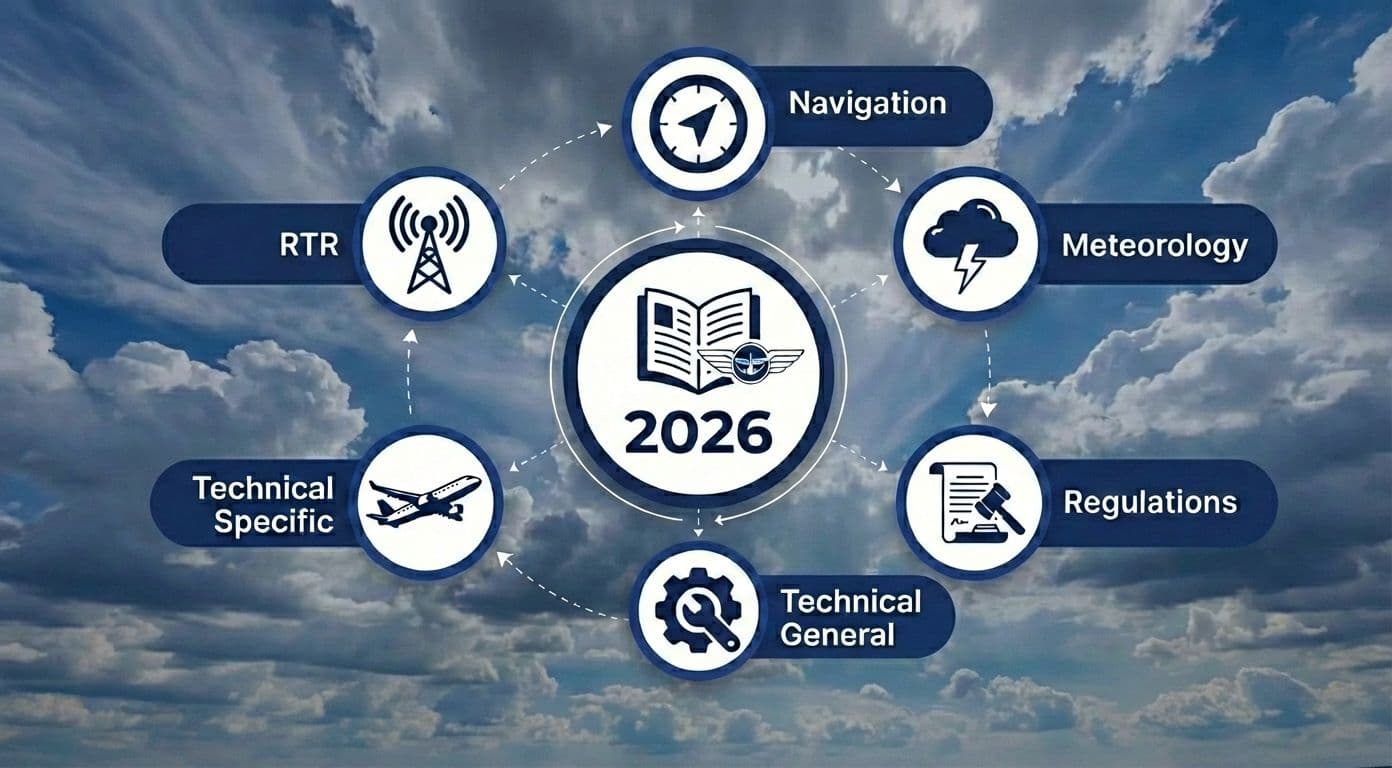
Under Section L, para 1(d), you must pass a written examination in:
- Air Regulations
- Air Navigation
- Avionics (Radio Aids and Instruments)
- Aviation Meteorology
- Aircraft and Engines
You must also pass a Signals (Practical) examination on interpreting aural and visual signals.
Exemption: if you hold a current CPL, you do not need to pass Air Regulations again.
DGCA's syllabus document, CAR Section 7, Series B, Part VI, lists the ATPL syllabus as Air Navigation, Aviation Meteorology, Radio Aids and Instruments, Air Regulation, Aircraft and Engines, a Technical Specific paper for the particular aircraft, and a Technical Performance paper. For how these subjects compare with the CPL papers, see our DGCA CPL exam pattern and syllabus guide.
How Long Do ATPL Exam Results Stay Valid?
Under First Schedule, Section A, para 8, technical and other examinations for a CPL or ATPL must be completed within five years before the date you apply for the licence. For most other licences and ratings, the window is two and a half years. If a result expires on a holiday, it stays valid until the next working day.
Applying for ATPL Papers on Pariksha (Current Process)
DGCA's Pariksha User Manual for Flight Crew Licence Examination (Issue III, October 2024) sets out what ATPL candidates must upload:
- Class 10 and 12 certificates, with 12th-grade Physics and Mathematics.
- Proof of an Indian CPL. Defence personnel can instead show 500 hours of flying, including 200 hours as pilot-in-command, with a certified flying summary and logbook pages.
- For Technical Specific or Technical Performance papers on aircraft above 5,700 kg MTOW, a certificate of completing ground training on that type at a DGCA-approved institute.
If you already have a Computer Number as a CPL candidate, you change your category from CPL to ATPL through a Category Update in your Pariksha profile. You can apply only once per session, and DGCA accepts no changes after you submit. Exam dates for the rest of the year are in our DGCA exam schedule 2026.
ATPL Skill Test
Under Section L, para 1(g), you must show your competency by day and by night on the multi-engine aeroplane type your licence application relates to, within six months before you apply. DGCA may allow all or part of the skill test on a Level D (zero flight time) simulator or an equivalent or higher approved device.
CPL holders may skip the general flying test. You do not need to take it if the ATPL is issued on a multi-engine type already in your CPL aircraft rating, and you have 10 hours as PIC or 20 hours as co-pilot on at least one such type in the previous six months.
Because the skill test is tied to a specific multi-engine type, you will need that type in your aircraft rating. Our type rating cost guide covers what those cost.
ATPL Fees in India
| Fee item | Amount | Source |
|---|---|---|
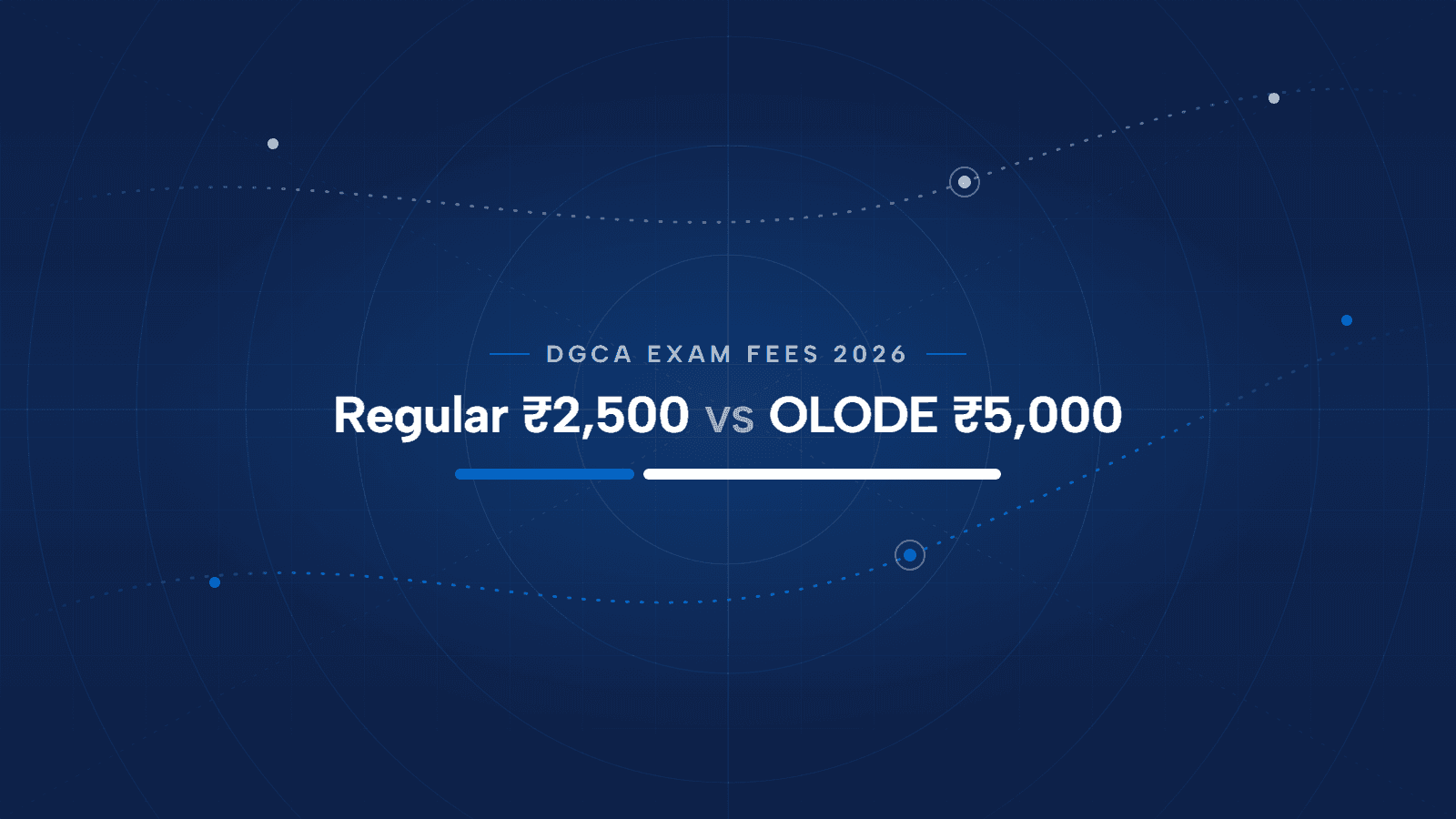
| DGCA exam, regular online session (current) | ₹2,500 per paper | Pariksha User Manual, Ch. 7 |
| DGCA exam, Online On-Demand (OLODE) (current) | ₹5,000 per paper | Pariksha User Manual, Ch. 8 |
| Oral paper, 2nd and 3rd attempt only (current) | ₹500 per paper | Pariksha User Manual, Ch. 7 and 8 |
| Online exam under new rules | ₹2,500 per paper | Bharatiya Vayuyan Niyam 2026, Rule 120 |
| Online on-demand exam under new rules | ₹5,000 per paper | Rule 120 |
| Issue of licence (other than Student or Glider Pilot) | ₹5,000 | Rule 120 |
| Renewal of licence | ₹2,500 | Rule 120 |
| Government examiner on board a flying test, multi-engine aircraft from 5,700 kg up to 50,000 kg MTOW | ₹50,000 | Rule 120(2) |
| Government examiner on board a flying test, multi-engine aircraft above 50,000 kg MTOW | ₹1,00,000 | Rule 120(2) |
Rule 120(2) also states that the candidate or operator must provide the aircraft or simulator for any flying test and bear all its costs. Our DGCA exam fees guide explains how per-paper fees add up and when an OLODE is worth it.
How to Get an ATPL in India: Step by Step
- Hold a DGCA CPL with a multi-engine instrument rating and a current FRTOL. If you are not there yet, start with our how to become a pilot in India guide.
- Keep your medical and English proficiency current. The ATPL medical must be renewed every 12 months, and you need at least ICAO Level 4 on your licence.
- Update your Pariksha category to ATPL and apply for the ATPL papers. Exam results stay valid for five years before your licence application.
- Build 1,500 hours with the PIC, cross-country, night, instrument and recent-flying minimums shown above, all recorded in a certified logbook.
- Pass the skill test on your multi-engine type within six months of applying, unless the CPL exemption applies.
- Apply to DGCA with your medical assessment, photographs, proof of age and fee paid electronically (First Schedule, Section A, para 9).
- Receive your ATPL as an Electronic Personnel Licence. According to PIB, DGCA launched EPL services for the ATPL on 21 January 2026, accessible through the eGCA mobile app.
- Complete command upgrade training with your operator before you act as a captain in commercial air transport.
Keeping Your ATPL Valid: Renewal and Age Limits
Licence validity: 10 years (rule 79).
Renewal requirements (Section L, para 3):
- A medical examination meeting the Section L standard.
- At least 10 hours as PIC in the 6 months before applying. Half of your co-pilot time can count towards this. Alternatively, you can pass the day and night flying tests in that period.
- A current FRTOL.
- A current instrument rating on a multi-engine aircraft.
Age limits (rule 113 and Section L, para 6):
- At 60 or above, you can act as PIC or co-pilot in commercial air transport only in a multi-crew operation where the other pilot is under 60. This does not apply to aircraft certified for single-pilot operation with an all-up weight up to 5,700 kg.
- At 65, you can no longer act as PIC or co-pilot in commercial air transport or fly for remuneration. ATPL privileges are then restricted to those of a Private Pilot's Licence.
Common Mistakes on the Road to an ATPL
- Letting exam results lapse. ATPL exam results count only if passed within five years before you apply for the licence.
- Uncertified logbooks. DGCA accepts flying experience only through a certified personal logbook or a certified extract.
- Assuming all hours count equally. Co-pilot time has crediting limits. Check how your hours count against the PIC and total requirements early.
- Letting the FRTOL or instrument rating lapse. Both must be current for both issue and renewal.
- Relying on agents. DGCA has warned candidates against brokers. Read our article on the DGCA exam fraud warning, and apply only through Pariksha and eGCA.
Official Sources (Checked 20 November 2026)
- Bharatiya Vayuyan Niyam, 2026 (G.S.R. 957(E), Gazette of India): First Schedule, Section L (ATPL Aeroplanes) and Section A; rules 79, 113 and 120.
- PIB Backgrounder: Bharatiya Vayuyan Niyam, 2026: commencement on 1 January 2027 and replacement of the Aircraft Rules, 1937.
- DGCA CAR Section 7, Series B, Part VI: ATPL (Aeroplanes) syllabus and the written-plus-oral requirement under the 1937 rules.
- DGCA CAR Section 7, Series G, Part III: English language proficiency, minimum ICAO Level 4.
- Pariksha User Manual for Flight Crew Licence Examination: ATPL eligibility documents, category update and exam fees.
- PIB: DGCA Launches EPL Services for ATPL: electronic ATPL via the eGCA app.
- Pariksha Notice Board: public notices and exam application windows.
DGCA is expected to issue updated procedures and CARs under the new rules. If anything changes before or after 1 January 2027, the DGCA website and Pariksha Notice Board will show it first.
Need Help Planning Your ATPL?
From exam timing to type rating choices, the right plan can save you months on the way to the left seat.
Book a Free Pilot Career Consultation with Apano Aviation →
Get personalised advice on DGCA exams, hour building, type ratings and your complete airline career roadmap, free of charge.
Last updated: 20 November 2026. Sources: Bharatiya Vayuyan Niyam, 2026 (Gazette of India), PIB, DGCA CARs and the Pariksha User Manual (all official).