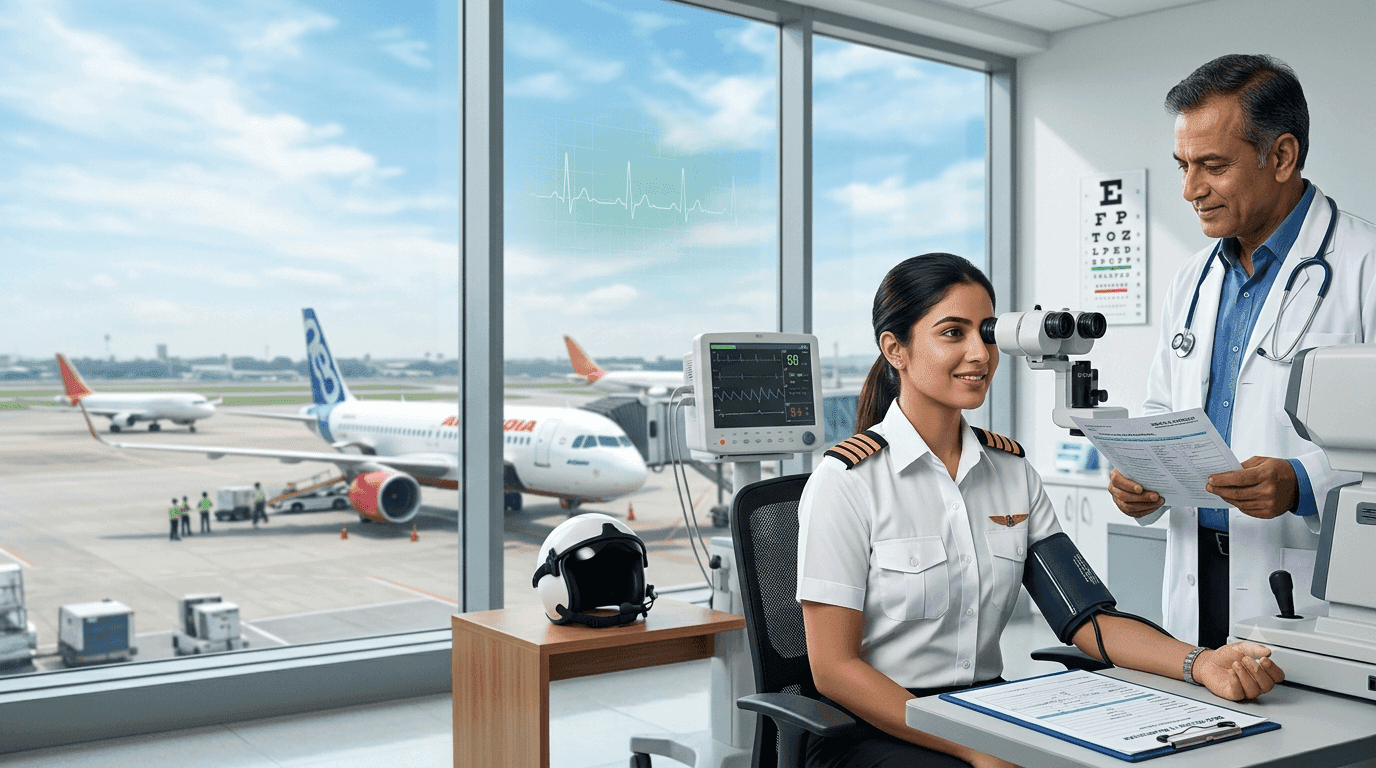


Understanding DGCA Medical Classes: Who Needs Class 1 vs Class 2
What Is a DGCA Class 1 Medical Certificate and Who Must Hold It
A DGCA Class 1 medical certificate represents the highest standard of medical fitness issued by India's Directorate General of Civil Aviation. It is mandatory for any pilot who holds or is applying for a Commercial Pilot Licence (CPL) or an Airline Transport Pilot Licence (ATPL) and intends to operate commercially within India. A pilot cannot exercise the privileges of these licences without a valid Class 1 certificate in hand — irrespective of their accumulated flying hours or simulator ratings.
Class 1 medical examinations are conducted at DGCA-designated Aviation Medical Centres and cover a broad range of physiological and psychological parameters: cardiovascular fitness, vision, hearing, neurological health, and mental well-being, among others. The standards are deliberately demanding. CPL and ATPL holders routinely carry fare-paying passengers and operate in high-pressure environments where fitness margins matter.
What Is a DGCA Class 2 Medical Certificate and Licence Eligibility
The DGCA Class 2 medical certificate is the required standard for student pilots and private pilots. If you are pursuing a Student Pilot Licence (SPL) or a Private Pilot Licence (PPL), a valid Class 2 certificate is your entry point. Examinations at this level are carried out by DGCA-approved doctors for Class 2 assessments, which makes the process considerably more accessible than the centralised Class 1 evaluation.
One point worth clarifying: holding a valid DGCA Class 1 medical automatically satisfies the Class 2 requirement. There is no need to obtain both certificates at the same time.
SPL, PPL, CPL, and ATPL: Matching the Right Medical Class to Your Licence
Different licences carry different medical requirements, and understanding this early can save considerable time and expense.
- SPL — A Class 2 certificate is the minimum required to begin solo flight training.
- PPL — A Class 2 certificate is required; a Class 1 is also accepted.
- CPL — Class 1 medical requirements under DGCA rules are mandatory. A Class 2 certificate alone is not sufficient.
- ATPL — A Class 1 certificate is compulsory and must remain current throughout active airline operations.
Key Differences Between Class 1 and Class 2 Medical Standards
Class 1 carries considerably stricter physiological and psychological benchmarks than Class 2. Cardiovascular thresholds, electrocardiogram requirements, and psychological screening are all assessed to a higher standard at the Class 1 level. Renewal intervals are also shorter for Class 1 holders — particularly for pilots above 40 years of age.
For those pursuing a commercial career, these requirements deserve careful attention during the planning stage. Undergoing a preliminary medical assessment early in your training journey is a sensible step. Identifying any potentially disqualifying conditions before committing to the full cost of CPL training can make a significant difference to both your timeline and your finances.
Medical Examination Process, Requirements, Validity, and Renewal
Obtaining a DGCA Class 1 Medical certificate involves a structured examination process that every aspiring or practising commercial pilot must navigate. Understanding what to expect — from the initial assessment to periodic renewals — helps candidates prepare thoroughly and avoid unnecessary delays.
The examination is conducted at DGCA-approved medical centres staffed by authorised Aviation Medical Examiners (AMEs). Before attending, candidates must ensure they carry valid identification, their logbook (where applicable), and any previous medical records or declared health history. First-time applicants will undergo a comprehensive evaluation, while renewal candidates may have a slightly streamlined process depending on their age and medical history.
The assessment covers several systems. Candidates are tested on vision and colour perception, hearing, cardiovascular function, respiratory health, neurological status, and general physical fitness. Blood and urine investigations are standard, and an electrocardiogram (ECG) is required from certain age thresholds onward. The examining AME may request additional specialist referrals if any finding warrants closer review.
Once issued, a Class 1 Medical certificate carries a defined validity period. For pilots below 40 years of age, the certificate is typically valid for 12 months. Pilots aged 40 and above are required to renew every six months. These intervals exist because physiological changes become more significant with age, and the aviation medical standards demand a higher frequency of monitoring to ensure continued fitness for duty.
Renewal follows the same examination framework as the initial assessment, though the AME will pay particular attention to any conditions flagged in previous certificates or declared since the last examination. Pilots managing controlled medical conditions — such as treated hypertension or stable diabetes — must provide updated specialist reports to demonstrate that their condition remains within acceptable limits.
Missing a renewal deadline renders the certificate invalid, which in turn affects the validity of the pilot's licence for commercial operations. It is advisable to schedule the renewal examination well before the expiry date to account for any administrative processing time or the possibility of a referral.
Class 1 vs. Class 2: What's the Difference?
If you are planning a career in aviation, understanding the difference between a Class 1 and a Class 2 medical certificate is one of the first things you need to get right. Both are issued under DGCA regulations, but they serve very different purposes and carry different standards.
Who Needs Each Class?
A Class 1 medical certificate is mandatory for anyone who wants to hold a Commercial Pilot Licence (CPL) or an Airline Transport Pilot Licence (ATPL). If you intend to fly passengers or work as a professional pilot, this is the certificate you must obtain and keep valid.
The Class 2 medical certificate is required for a Student Pilot Licence (SPL) and a Private Pilot Licence (PPL). It is the entry point for those learning to fly recreationally or just beginning their training journey.
How the Medical Standards Differ
The Class 1 standard is considerably more rigorous. DGCA examiners assess a broader range of systems and apply stricter thresholds across vision, cardiovascular health, neurological function, and mental fitness. The reasoning is straightforward: a commercial pilot carries responsibility for hundreds of passengers and must meet a higher level of physiological reliability.
Here is how the two classes compare across key areas:
- Vision: Class 1 requires corrected visual acuity of 6/6 in each eye. Class 2 permits slightly relaxed thresholds.
- Cardiovascular: Class 1 mandates an ECG from the initial examination. Class 2 introduces ECG requirements only at later ages.
- Validity period: Class 1 certificates are valid for 12 months for pilots under 40, and 6 months for those aged 40 and above flying multi-crew operations. Class 2 certificates are generally valid for 24 months for pilots under 40.
- Approved examiners: Both certificates must be issued by DGCA-approved doctors, but the pool of examiners authorised to conduct Class 1 assessments is smaller and specifically designated.
Please note: Holding a valid Class 2 certificate does not allow you to exercise the privileges of a CPL or ATPL. Always confirm which class your licence requires before booking your medical examination.
Choosing the Right Starting Point
Many aspiring commercial pilots choose to sit their Class 1 medical before enrolling in a flying school. This is a practical decision. If you cannot meet the Class 1 requirements that DGCA sets out, it is far better to find out early than after investing years of time and money into training.
Passing the Class 1 examination also automatically satisfies the Class 2 standard, so there is no need to obtain both separately.
Speaking with DGCA-approved doctors for a Class 1 or Class 2 assessment early in your planning will give you a clear picture of where you stand before you commit to any training programme.
Class 2 Medical: Step-by-Step, From Scratch
Getting a Class 2 Medical certificate can feel overwhelming if you have no idea where to start. This section walks you through the entire process, step by step, so you know exactly what to expect before you walk into that examination room.
The Class 2 Medical is the standard medical certification required for student pilots and private pilots in India. It is conducted under the guidelines set by the DGCA, and clearing it is one of the first formal steps in your aviation journey.
Before booking your appointment, gather your documents. You will typically need your passport-size photographs, a valid government-issued photo ID, your educational certificates, and any previous medical records that may be relevant. Having these ready in advance saves you from unnecessary delays.
The examination itself covers several systems. Doctors will assess your vision, hearing, cardiovascular health, respiratory function, and general physical condition. Blood and urine tests are standard. An ECG may also be required depending on your age. The process is thorough, but it is not designed to be intimidating — it is simply a structured check to confirm you are fit to operate an aircraft safely.
Many candidates also ask about the DGCA Class 1 Medical at this stage, which is the higher-grade certification required for commercial pilots. While the Class 2 and Class 1 examinations share several common components, the Class 1 applies stricter standards across most parameters. If your long-term goal is a commercial licence, it is worth understanding both from the beginning so you can plan accordingly.
Once your examination is complete and results are reviewed, the certificate is issued through the DGCA's designated process. The validity period and renewal schedule will be communicated to you at that point.
Approach this process with preparation rather than anxiety. Most candidates who come in organised and informed clear it without difficulty.
Class 1 Medical: Step-by-Step, From Scratch
Getting a Class 1 Medical certificate can feel overwhelming if you have no idea where to start. This section walks you through the entire process in a clear, logical sequence — so you know exactly what to expect at each stage.
The Class 1 Medical is issued by the DGCA and is mandatory for anyone pursuing a commercial pilot licence. Unlike the Class 2, which applies to student and private pilots, the Class 1 sets a higher medical standard. That means a more thorough examination across multiple systems — vision, hearing, cardiovascular health, neurological function, and more.
Before you book your appointment, gather your documents. You will typically need your passport, photographs, a filled DGCA application form, and any previous medical records that may be relevant. Arriving prepared saves time and avoids unnecessary delays.
The examination itself is conducted at a DGCA-approved Aviation Medical Centre. A panel of medical examiners assesses each system individually. Some tests are straightforward, like the vision and hearing checks. Others, such as the ECG or the lung function test, take a bit more time. The examiners are experienced and will guide you through each step.
Once all tests are completed, the findings are reviewed and submitted to the DGCA. If everything is within the accepted limits, your Class 1 certificate is issued. If a particular result requires further review, the DGCA may ask for additional reports or a specialist consultation before a final decision is made.
The certificate, once granted, is valid for a defined period depending on your age. Renewal follows a similar process, though the frequency increases as you get older. Keeping track of your renewal dates is something every commercial pilot needs to manage carefully.
Approximate Costs
Knowing what you are likely to spend before training begins makes it far easier to plan your finances with confidence. The fees for a DGCA Class 1 medical examination are set by each authorised medical centre, so costs can vary depending on the city and facility you select.
As a general guide, the initial Class 1 examination typically falls between ₹8,000 and ₹15,000 at most DGCA-approved centres across India. This range covers the core tests — ECG, audiometry, vision assessment, blood work, and the consultation with your Aviation Medical Examiner (AME). Centres in metro cities such as Delhi and Mumbai tend to charge toward the upper end.
Approximate fee ranges:
- Initial Class 1 examination: ₹8,000 – ₹15,000 (all mandatory tests included)
- Renewal examination: ₹5,000 – ₹10,000, depending on age and tests required
- DGCA Class 2 medical certificate: ₹3,000 – ₹6,000, making it a more accessible starting point for student pilots
- Additional specialist referrals: ₹500 – ₹3,000 per specialist, should any borderline finding require further evaluation
A word of caution: Always confirm the current fee schedule directly with your chosen centre before booking your appointment. Fees are not standardised by DGCA and can change without prior notice.
Many aspiring pilots start with the Class 2 certificate. The cost is lower, and while the standards remain rigorous, they are slightly less demanding than Class 1. Passing Class 2 also gives you a reasonable indication of your overall medical fitness before committing to the higher expense of a full Class 1 assessment.
When budgeting, remember to account for travel if the nearest approved centre is not in your home city. Some candidates also choose to visit a general physician beforehand for a preliminary check-up — a practical step that can flag potential issues early and save both time and money during the formal assessment.
Clearing the Class 1 medical requirements is a one-time investment that underpins your entire flying career. Treat it as a priority, not an afterthought.
Official Resources — Examiner & Hospital Lists, By Zone
Rather than reproducing static contact lists here (which DGCA revises periodically), use the links below to pull the current official documents directly. Each is published and maintained by DGCA itself.
Class 1 — IAF Boarding Centres, Civil Hospitals & Empanelled Examiners
Official Class 1 list (PDF, DGCA)
This document lists the three IAF Boarding Centres (Delhi, Jorhat, Bengaluru), the ten DGCA-approved civil hospitals authorised for Initial/Re-Initial exams, the eighteen IAF centres authorised for Renewal exams, and the full panel of around fifty-five DGCA-empanelled civil Class 1 examiners, with their city, contact number, and empanelment validity.
Class 2 — Region-wise Empanelled Examiners
Official Class 2 list (PDF, DGCA)
This document organises Class 2 examiners into four broad zones:
- Northern Region — predominantly Delhi-NCR (Delhi, Gurugram, Noida, Faridabad), plus Punjab, Haryana, Rajasthan, Uttar Pradesh, Uttarakhand, and Himachal Pradesh.
- Southern Region — predominantly Bengaluru and Chennai, plus other centres in Karnataka, Tamil Nadu, Telangana/Andhra Pradesh, and Kerala.
- Western Region — predominantly Mumbai and Pune, plus other centres in Maharashtra, Gujarat, and Madhya Pradesh.
- Eastern Region — predominantly Kolkata, plus other centres in Odisha, Jharkhand, Bihar, and Assam.
Each entry gives the doctor's name, clinic/hospital address, phone number or email, and the validity period of their DGCA empanelment — check that the empanelment date hasn't lapsed before booking.
Other Official Links
- eGCA Portal (login, applications, NOC requests)
- DGCA Home / Personnel / Medical section
- Civil Aviation Requirements, Section 7 Series C (medical fitness rules) — available under Regulations & Guidance → Requirements and Guidance → Civil Aviation Requirements on the DGCA website.
Tip: Bookmark the two PDF links above rather than saving a downloaded copy — DGCA updates these in place, and the same URL will always reflect the latest empanelment list.