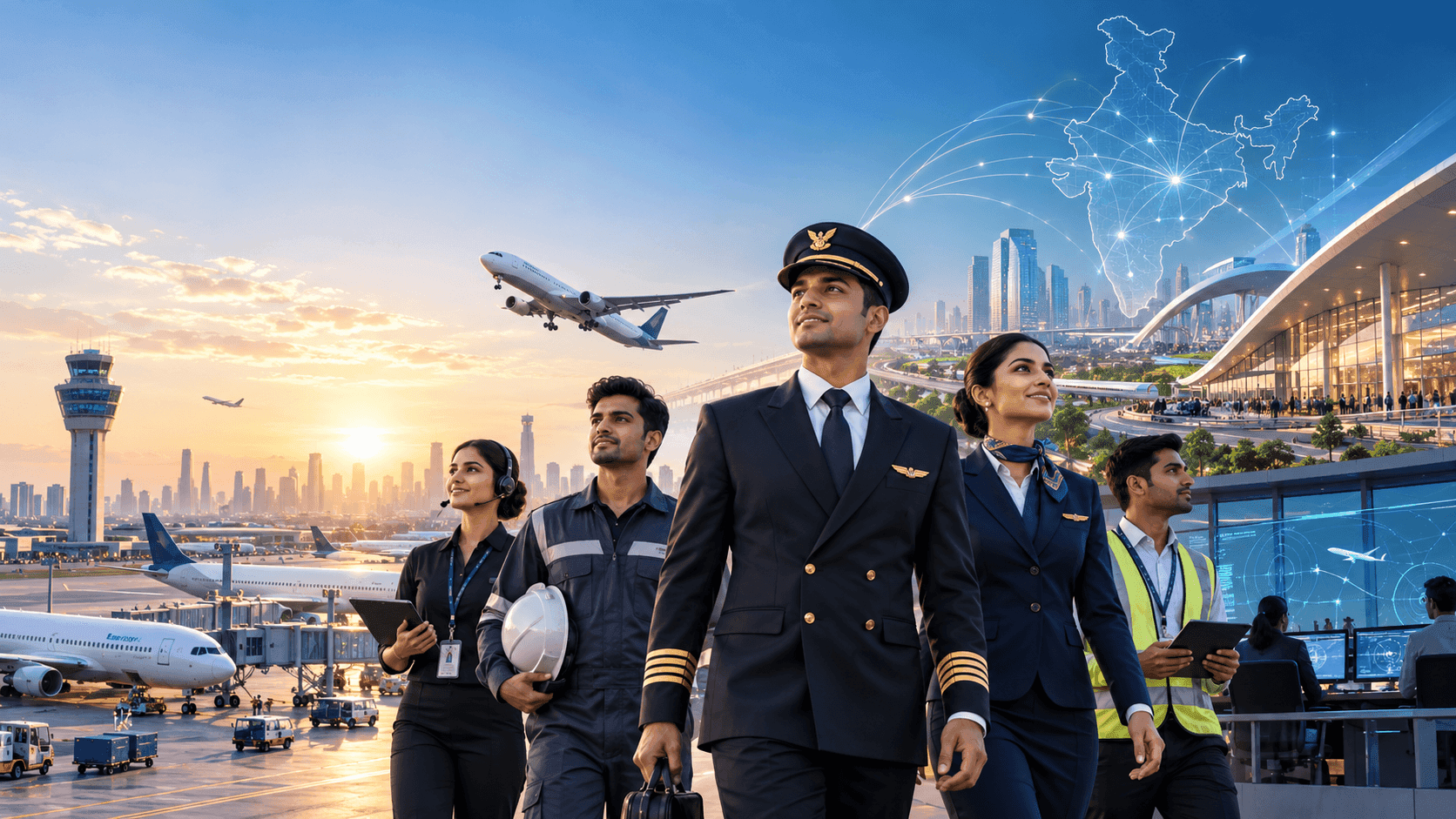

Picture this: It is 5:30 AM at Chhatrapati Shivaji Maharaj International Airport in Mumbai. The city below is still asleep, but in the cockpit of an Airbus A320, a young First Officer runs through pre-flight checks with quiet precision. Six years ago, she was a Class 12 student in Pune, unsure of how to pursue her dream of flying. Today, she commands one of the most advanced aircraft in the world and earns more in a month than most professionals do in three.
Her story is not unique — it is becoming increasingly common. India is the world's third-largest aviation market, with airlines like IndiGo, Air India, and Akasa Air in aggressive expansion mode. Indian carriers have placed orders for over 1,700 new aircraft. The Civil Aviation Ministry projects a need for over 25,000–30,000 new commercial pilots over the next decade. The demand for qualified CPL holders has never been higher.
Not sure where to start? Talk to our aviation career experts for free and get a personalised roadmap based on your background.
Section 1: Eligibility — Are You Ready for the Cockpit?
Before you spend a single rupee on training, you need to know whether you meet the foundational requirements set by the DGCA. These are non-negotiable:
Age: You must be at least 18 years old at the time of CPL application.
Education: Class XII (10+2) with Physics and Mathematics as mandatory subjects. Most Flying Training Organisations (FTOs) expect a minimum of 50% aggregate marks.
Medical Fitness: You must pass both a DGCA Class 2 and Class 1 Medical Examination (details in Steps 2 and 3 below).
Nationality: You must be an Indian citizen or meet DGCA's prescribed nationality criteria.
💡 If Physics and Maths aren't your strong suits: Start strengthening them now — these subjects form the intellectual backbone of everything from aerodynamics to navigation calculations. You can also qualify through NIOS or any recognised open board.
📖 Check full details: Aviation Course Eligibility Criteria in India
Section 2: The 7-Step CPL Process — Your Journey, Step by Step
The path to a Commercial Pilot Licence in India is clearly structured by the DGCA. Here is exactly what you need to do, in order:
Step 1
Create Your eGCA ID
Your aviation journey begins online. The DGCA's eGCA portal is the digital gateway for all pilot licensing activities in India. You will register, upload identity documents and educational certificates, and create your official pilot profile. Every future licensing action — from medical certificates to the CPL application itself — flows through this portal.
Think of your eGCA ID as your digital cockpit door — getting it set up correctly from day one saves significant paperwork later.
Step 2
Class 2 Medical Examination
Before any flying begins, candidates must undergo a baseline health assessment conducted by a DGCA-approved Aviation Medical Examiner (AME). It covers vision (including colour perception), hearing, cardiovascular basics, and general physical fitness.
Do this early — ideally before investing in coaching or application fees. A disqualifying condition discovered at this stage saves years of misdirected effort and lakhs of rupees.
Step 3
Class 1 Medical Examination
The Class 1 Medical Certificate is the gold standard in aviation fitness — and it is mandatory for the CPL. Conducted at DGCA-approved medical centres (including Air Force Medical Centres like AFCME New Delhi, IAM Bengaluru, and MEC Mumbai), this comprehensive examination assesses cardiovascular health (ECG), neurological fitness, vision and colour perception to stricter standards, and psychological suitability. Once issued, this certificate must be renewed annually throughout your flying career.
Your Class 1 Medical is not a one-time milestone but a lifelong professional standard — treat your health accordingly.
Step 4
Obtain Your DGCA Computer Number via the Pariksha Portal
To sit for DGCA theory examinations, you must first register on the Pariksha.DGCA portal and obtain a DGCA Computer Number. This unique identifier links your exam history, scores, and subject clearances to your eGCA pilot profile. Without this number, you are not permitted to appear for any written tests.
📖 Step-by-step walkthrough: How to Get DGCA Computer Number
Step 5
Clear DGCA Theory Examinations
This is the academic heart of your CPL journey. DGCA mandates that candidates clear the following six subjects before commencing flying training:
- Air Navigation — Principles of navigation, charts, GPS, dead reckoning, and en-route calculations.
- Meteorology — Weather systems, cloud types, icing, turbulence, and how weather impacts flight.
- Air Regulation — Indian and international aviation laws, DGCA rules, and ICAO standards.
- Technical General — Aircraft systems, engines, aerodynamics, and instrument principles.
- Technical Specific — Systems specific to the aircraft type flown during training.
- RTR (Radio Telephony Restricted) — Conducted by the Ministry of Communications; certifies you for aviation radio communication.
Pass threshold: 70% in each subject. Many candidates underestimate the depth of these papers — invest in quality study material and past question banks. Clearing all six on the first attempt saves both money and time.
📖 Related reading:
DGCA CPL Exam Pattern & Syllabus 2026
Which DGCA Exam to Give First? Sequence & Validity Guide
How to Clear DGCA Exams in First Attempt
Best Books for DGCA CPL Exams 2026
Approach each theory subject not as an obstacle but as a foundation — this knowledge will keep you and your passengers safe every time you take command.
Step 6
Enrol at a DGCA-Approved Flying Training Organisation (FTO)
Once your theory exams are cleared, it is time to strap in. You must enrol at a DGCA-approved Flying Training Organisation — a government-certified flying school where structured ground school and actual flight training take place. India now has approximately 40 DGCA-approved FTOs with 385 trainer aircraft across the country. Government options include the prestigious IGRUA in Fursatganj (UP) and state government-run flying clubs. Numerous private FTOs operate across India and abroad (USA, Australia, South Africa).
Before signing any agreement: Check DGCA approval status on the official DGCA website, inspect the training fleet condition, ask about average batch completion rates, and speak to recent alumni.
Step 7
Complete 200 Flying Hours and Apply for Your CPL
The DGCA mandates a minimum of 200 total flight hours for CPL issuance, including dual instruction hours, solo flight hours, cross-country navigation flights, and night flying. The complete flying programme usually takes 18 to 24 months. Once you have accumulated required hours, cleared all theory subjects, passed the DGCA skill test, and hold a valid Class 1 Medical Certificate, you can formally apply for your Commercial Pilot Licence.
Every single flight hour builds the aviator you are becoming — treat each sortie as both training and joy.
Section 3: Training Duration and Costs
CPL training in India is a significant financial undertaking. Here is what to expect:
| Training Route | Duration | Estimated Cost |
|---|---|---|
| Government FTOs (IGRUA, state-run) | 18–24 months | ₹15–20 lakhs |
| Private FTOs (Indian schools) | 18–24 months | ₹40–60 lakhs |
| Independent CPL Route (typical total) | 18–24 months | ₹35–55 lakhs |
| Airline Cadet Programmes | 18–30 months | ₹85 lakhs – ₹1.2 crore |
| Type Rating (Airbus A320 / Boeing 737) — post-CPL | 2–3 months | ₹10–15 lakhs |
Most major banks (SBI, Bank of Baroda, Axis, HDFC) offer education loans for pilot training. Airline cadet programmes — where the airline partially funds your training in exchange for a service bond — are also an increasingly popular pathway. Build a financial plan early and explore scholarships, family support, and loan repayment scenarios before committing.
The cost is real, but so is the return — a career that pays back the investment within five to eight years of airline employment.
Section 4: Career Opportunities After CPL
Your CPL opens doors across a surprisingly broad aviation ecosystem. Here are the primary career paths:
- First Officer / Co-Pilot at domestic airlines: IndiGo, Air India, SpiceJet, and Akasa Air are among the major recruiters. Entry-level pilots typically begin as First Officers.
- Charter and corporate jet pilot: High-net-worth individuals and corporate houses hire CPL holders for private jet operations — often with premium compensation and flexible schedules.
- Cargo pilot: Driven by India's e-commerce explosion and supply chain growth, cargo aviation is rapidly expanding and offers stable employment.
- Flight instructor at an approved FTO: Teaching the next generation of pilots is personally fulfilling and professionally valuable — instructing hours count toward your overall flight experience.
- Regional aviation under the UDAN scheme: The Government of India's UDAN initiative is connecting Tier-2 and Tier-3 cities to aviation, creating demand for pilots on smaller regional aircraft.
- Path to ATPL (Airline Transport Pilot Licence): After accumulating 1,500 flight hours and meeting DGCA criteria, CPL holders can upgrade to an ATPL — the licence required to act as Pilot-in-Command on commercial airliners.
Indian aviation's rapid growth means that career progression from First Officer to Captain is happening faster than it did a decade ago — at airlines like IndiGo, command upgrades now happen in 5–7 years instead of the typical 8–10.
🎯 Confused about which career path suits you best? Our aviation career counsellors can assess your profile, confirm your eligibility, and help you shortlist the right FTOs and career track — completely free. 👉 Book Your Free Career Consultation
Section 5: Salary Expectations
Here is realistic, tiered pilot salary data to help you plan your financial future (current Indian market conditions, 2026):
| Career Stage | Experience | Monthly Salary |
|---|---|---|
| Fresh CPL / First Officer | 0–2 years | ₹1–2.5 lakh/month |
| Senior First Officer | 3–5 years | ₹3.5–4.5 lakh/month |
| Captain / Commander (domestic narrow-body) | 6–10 years | ₹5–10 lakh/month |
| International Airline Captain (Gulf carriers) | 10+ years | ₹12 lakh+/month (tax-free) |
Beyond base salary, pilots typically enjoy complimentary or heavily discounted air travel, comprehensive health insurance, and in some cases housing allowances. The total compensation package consistently makes commercial aviation one of the highest-paying professions in India.
Patience in the first two years pays dividends — the pilot pay curve in aviation is steep and consistently upward.
📖 Full breakdown: Pilot Salary in India 2026: Complete Guide
Section 6: Challenges to Anticipate
- High upfront training cost and debt management: Training fees are substantial (₹35–80 lakh for independent route), and loan repayments begin before you draw a full commercial salary. Budgeting carefully during training is essential.
- Competition for limited FTO seats: Government schools are coveted and seats are scarce. Apply early and have contingency plans.
- DGCA theory exams: These examinations are rigorous. Failing a subject and re-sitting costs money and delays your timeline.
- Medical fitness maintenance: A Class 1 medical disqualification mid-career is a pilot's worst professional nightmare. Sleep, diet, exercise, and mental health are career maintenance — not lifestyle choices.
- Airline hiring cycles: Airlines recruit in waves tied to fleet expansion and economic conditions. There may be a gap between CPL issuance and your first airline offer. Use this time to build hours as an instructor or in charter aviation.
- New FDTL rules: The updated DGCA Flight Duty Time Limitation rules in 2026 have changed crew rostering — while this increases demand for pilots, it also means airlines are more selective about hiring airline-ready candidates.
Every challenge here is surmountable with the right preparation — the pilots who succeed are not always the most naturally gifted, but they are consistently the best prepared.
Section 7: Pro Tips for Aspiring Pilots
- Start with strong academics in Physics and Mathematics. Class 11 and 12 are not merely about board exam scores — they determine whether you are intellectually equipped for aviation theory. Build genuine understanding, not just exam-passing tricks.
- Get a Class 2 medical check early — before committing to coaching fees or family financial planning. Discovering a disqualifying condition at the outset is far better than discovering it after investing two years and twenty lakhs.
- Research FTOs with rigour. Verify the school's current DGCA approval status, inspect the training fleet, ask about batch completion rates, and speak to recent alumni. India now has ~40 approved FTOs — quality varies significantly.
- Build your financial plan before you begin. Explore bank education loans, airline cadet sponsorship programmes, scholarships from the Ministry of Civil Aviation, and establish a realistic repayment timeline.
- Pursue a Type Rating on high-demand aircraft after your CPL. The Airbus A320 and Boeing 737 dominate Indian airline fleets. Holding a Type Rating at the time of interview dramatically accelerates the hiring process.
The pilots who stand out in interview rooms are not always those with the most hours — they are the ones with the most preparation, the clearest vision, and the deepest understanding of why they fly.
Frequently Asked Questions
Can I become a commercial pilot without Physics and Maths in Class 12?
Currently, Physics and Mathematics at 10+2 level are mandatory. However, you can qualify by clearing these subjects through NIOS or any recognised open board. A DGCA reform that would allow Arts and Commerce students to apply directly is approved but awaiting final Ministry clearance.
Is there an upper age limit for CPL training in India?
DGCA sets no upper age limit for CPL training. However, most airlines prefer candidates under 32–35 years for first officer hiring. Starting earlier gives you more career runway.
I wear glasses — can I still become a commercial pilot?
Yes. Vision must be correctable to 6/6 in one eye and 6/9 in the other with glasses or contact lenses. Severe colour blindness, however, is a disqualification.
How long does it take to get a CPL in India?
The complete process — from DGCA registration and theory exams to completing 200 flying hours — typically takes 2 to 3 years, depending on weather, batch schedules, and how quickly you clear theory exams.
What is the best FTO in India for pilot training?
IGRUA (Indira Gandhi Rashtriya Uran Akademi) is the most prestigious government FTO, though seats are extremely competitive. Among private FTOs, research DGCA approval status, fleet condition, and batch completion rates rather than relying on reputation alone.
Can banks in India give loans for CPL training?
Yes. SBI, Bank of Baroda, Axis, and HDFC all offer education loans for pilot training. Loan amounts and interest rates vary — compare offers and factor in the moratorium period before repayments begin.
How much does a commercial pilot earn in India?
Fresh First Officers earn ₹1–2.5 lakh/month. Senior First Officers earn ₹3.5–4.5 lakh/month. Captains on domestic narrowbody aircraft earn ₹5–10 lakh/month, while international widebody captains can earn ₹12–20 lakh/month or more.
📖 Read next:
How to Become a Pilot in India
DGCA Exam Schedule 2026: All Important Dates
DGCA Previous Year Question Analysis 2026
Ready to Start Your Pilot Journey?
Our aviation career counsellors can assess your profile, confirm your eligibility, and help you shortlist the right FTOs — completely free.