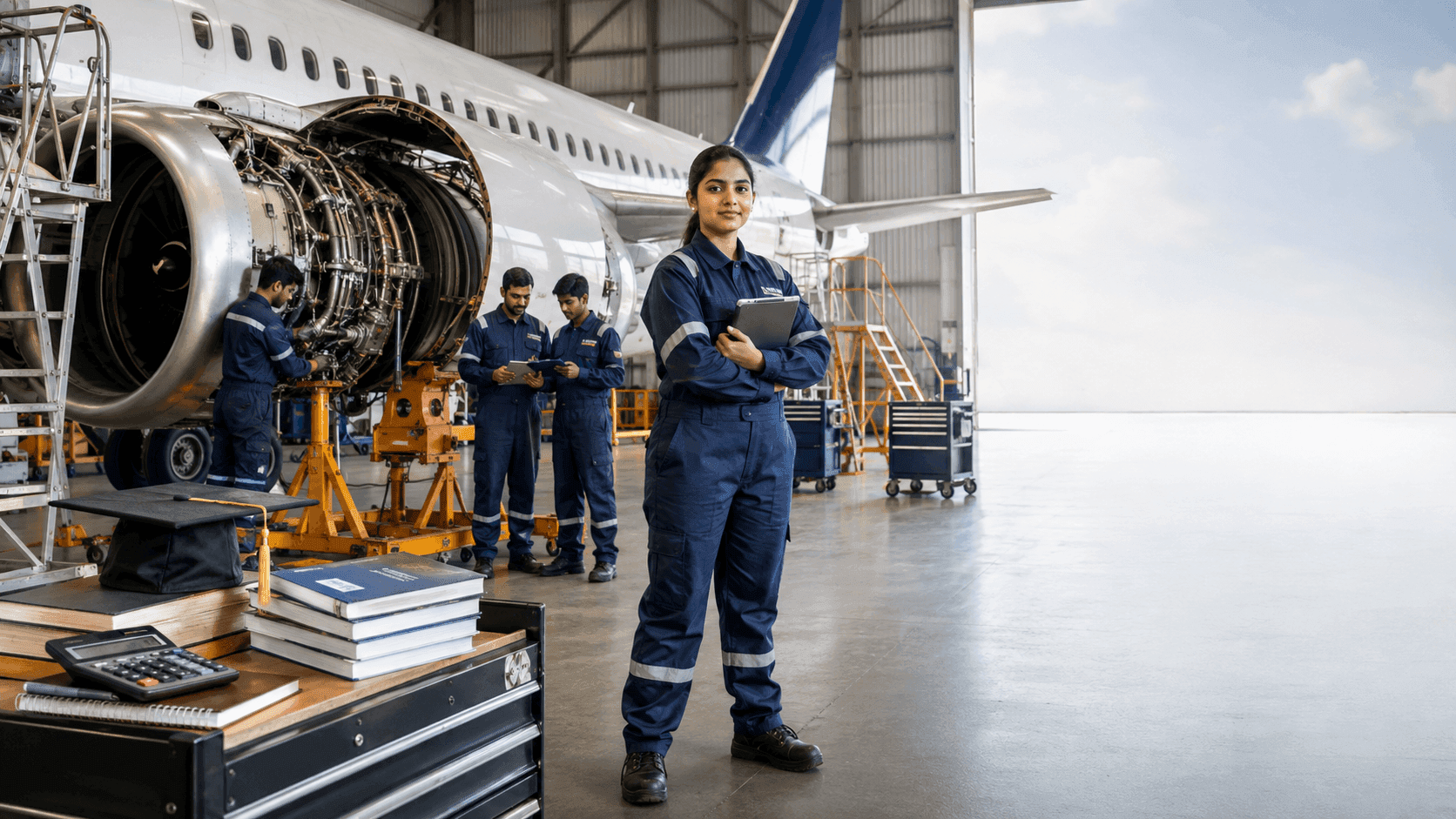


AME course fees in India for 2026 typically fall between ₹3,00,000 and ₹9,00,000 for the full DGCA-approved training programme, with most students paying ₹4.5–6.5 lakh at a mid-tier private institute for the standard B1.1 (Mechanical) or B2 (Avionics) category. The number that actually applies to you depends heavily on which licence category, institute, and city you're comparing — this guide breaks the cost down on every one of those axes, with figures checked against institutes' own fee pages where available.
Quick-Answer: AME Fee Range by Category
| Category | What It Covers | Course Duration | Typical Total Fee |
|---|---|---|---|
| B1.1 (Aeroplane Turbine) | Mechanical/airframe & powerplant, jet-engine aircraft | 2 years academic (2,400 training hrs) | ₹4,50,000 – ₹6,50,000 |
| B1.2 (Aeroplane Piston) | Mechanical/airframe & powerplant, piston-engine aircraft | 2 years academic (2,000 training hrs) | ₹3,50,000 – ₹5,00,000 |
| B2 (Avionics) | Electrical, instrument & radio navigation systems | 2 years academic (2,400 training hrs) | ₹4,50,000 – ₹6,50,000 |
| AME + B.Tech/B.Sc (dual programme) | AME licence + engineering degree, offered by select institutes | 3–4 years | ₹5,50,000 – ₹9,00,000+ |
Course duration and hours are per CAR-147 (Basic) Appendix I, DGCA's approved-training-organisation standard — not the "4-year, 3+1" structure sometimes quoted online, which reflects an older pattern. After the academic course, you still need supervised practical maintenance experience before DGCA issues the full licence — see the CAR-66 section below.
🎯 Not sure which AME category or institute fits your budget? Talk to our aviation career experts — completely free.
Named Institute Fee Comparison
| Institute | Category Offered | Total Course Fee | Duration |
|---|---|---|---|
| Silver Oak College of Aviation Technology (SOCAT), Ahmedabad | B1.1 / B2 | ~₹5,30,000 | 3 years |
| Indian Aerospace and Engineering, Navi Mumbai | B1.1 / B2 | ~₹6,25,000 | 3 years |
| NDC Institute of AME | B1.1 / B2 | ~₹9,19,000 (specific programme path) | Varies by semester structure |
| Indian Institute of Aircraft Engineering (IIAE), Dwarka, New Delhi | B1.1 / B2 | ~₹6,00,000 | 2 years |
| SSAT India | B1.1 (Turbine) / B2 | ~₹6,25,000 · B1.2 (Piston): ~₹4,50,000 | 2 years |
| Indira Institute of Aircraft Engineering, Pune | AME + B.Sc (Avionics/Mechanical) | ₹5,70,000 – ₹7,80,000 | 3 years |
Figures are institute-reported or third-party aggregator data as of mid-2026 — confirm current fees directly with the institute before enrolling, as these revise annually and vary by seat category (management/NRI seats typically cost more). Institutes marked with a link have full profiles on Apano where you can see courses, addresses, and contact details directly. Browse the complete list of DGCA-approved AME institutes on Apano.
What's in the Fee — and What's Usually Extra
| Fee Component | Typical Range | Notes |
|---|---|---|
| Registration/admission fee | ₹1,000 – ₹15,000 | One-time, usually non-refundable |
| Academic/tuition fee | ₹2,50,000 – ₹5,00,000 | Paid semester-wise across the 2-year course |
| Practical/workshop/lab fee | ₹50,000 – ₹1,50,000 | Sometimes bundled into tuition, sometimes billed separately if outsourced to a CAR-145 organisation |
| Library, study material & exam fees | ₹10,000 – ₹40,000 | Covers internal assessments and module exam administration |
| Uniform, safety gear & tools | ₹10,000 – ₹30,000 | Coveralls, safety boots, basic toolkit |
| Hostel/accommodation (optional) | ₹60,000 – ₹1,20,000/year | Not mandatory at most institutes — day-scholar option usually available |
| Type rating (post-licence, optional) | ₹1,00,000 – ₹5,00,000+ | Aircraft-type-specific (e.g., A320, B737), needed only once employed and required by your employer |
Always request an itemised quote covering every row above — the gap between an institute's advertised headline number and your actual out-of-pocket total is almost always hidden in tuition-vs-practical-vs-hostel splits.
CAR-66 Licensing: Why It Drives the Cost
CAR-66 is DGCA's licensing regulation for Aircraft Maintenance Engineers, issued under Rule 61 of the Aircraft Rules, 1937, and broadly aligned with EASA's Part-66 framework. It defines the licence categories — A, B1 (with sub-categories B1.1 to B1.4), B2, B2L, B3, C, and L — and what each is legally authorised to certify:
- Category A — minor scheduled line maintenance and simple defect rectification
- Category B1 — mechanical/airframe & powerplant systems (sub-categories by engine/aircraft type)
- Category B2 — avionics, electrical and radio navigation systems
- Category C — base maintenance certification on larger aircraft
The training organisation that delivers your course must itself hold CAR-147 (Basic) approval from DGCA — this is what's meant by "DGCA-approved AME institute." CAR-147 (Basic) fixes the minimum training hours by category (2,400 hrs for B1.1/B1.3/B1.4/B2, 2,000 hrs for B1.2), which is the real driver of why AME courses run longer and cost more than most diploma programmes — the institute is required to maintain aircraft-grade labs, simulators, and CAR-145-linked practical placements to deliver that curriculum, not just classrooms.
This regulatory overhead is exactly why AME fees don't compress the way generic vocational course fees do — you're paying for mandated infrastructure, not just tuition.
Does Category (B1 vs B2) Change the Cost?
Not dramatically at the base course level — B1.1 and B2 are priced similarly at most institutes since both require 2,400 training hours and comparable lab investment (turbine/airframe labs for B1.1, avionics/electrical labs for B2). Where costs diverge:
- B1.2 (Piston) tends to run ₹1–2 lakh cheaper than B1.1/B2, reflecting the lower 2,000-hour minimum and simpler equipment requirements
- Type rating (aircraft-model-specific certification like A320 or B737) is a separate, later cost — often ₹1–5 lakh — and is usually sponsored by your employer once hired, not paid out of pocket during the base course
- AME + engineering degree dual programmes cost more (₹5.5–9 lakh+) but add a B.Tech/B.Sc alongside the licence — worth it mainly if you want the degree as a fallback/abroad-migration option, not for the AME licence alone
Scholarships and Entrance Exams
Unlike CPL or cabin crew training, DGCA does not mandate any entrance exam for AME admission — institutes can admit directly against the eligibility criteria (10+2 with Physics, Chemistry, and Mathematics, or a relevant 3-year diploma). However, several private aggregator-run exams have become de facto scholarship gateways:
- AME CET / AIAEE (Aircraft Maintenance Engineering Common Entrance Test / All India Aircraft Engineering Entrance Exam) — used by some institute networks as a merit-and-scholarship-linked exam, not a DGCA-mandated one
- IASAT (International Aviation Scholarship and Aptitude Test) — another aggregator-run scholarship exam feeding into partner AME colleges
These can meaningfully reduce your fee (institutes advertise merit-based waivers), but confirm the scholarship terms in writing and verify which specific institutes honour it — these are third-party exams, not government-administered ones, and terms vary by admission cycle.
Education loans are widely available from banks for AME programmes since institutes are DGCA-recognised; ask your institute's admissions office for their loan-partner list.
Is It Worth the Cost?
India's civil aviation fleet and MRO (Maintenance, Repair & Overhaul) sector are expanding quickly, and industry estimates cited by aviation training platforms put AME/technician hiring at roughly 72,900 new jobs by 2035 across airlines and MRO. Starting salaries for freshly licensed AMEs commonly fall in the ₹4–8 lakh/year range, rising into the ₹15–25 lakh+ range with experience at major airlines and MRO facilities — though these are industry-reported figures, not government statistics, so treat them as directional rather than guaranteed.
Against a ₹4.5–6.5 lakh course investment, the bigger driver of ROI is whether the institute has genuine airline/MRO placement tie-ups (not just a marketing claim) and whether its CAR-147 approval and lab infrastructure are current — verify both directly with DGCA and the institute before enrolling, not just from the institute's own brochure.
🔧 Wrenches over runways — is AME your real calling? Get a free, no-obligation career consult from Apano's aviation experts.
Sources: DGCA CAR-147 (Basic) Issue 1 (dgca.gov.in) for training-hour standards; DGCA CAR-66 and Rule 61 of the Aircraft Rules, 1937 for licensing categories; institute fee data cross-referenced against SOCAT's official site, Indian Aerospace and Engineering's official fee page (via Apano's own institute profile), amecollege.in, collegedekho.com, and collegedunia.com institute listings (2025–26); industry hiring projection via amecollege.in citing sector reports. Institute-specific fees are third-party reported except where noted as institute-published — confirm current fees directly with the institute before enrolling.