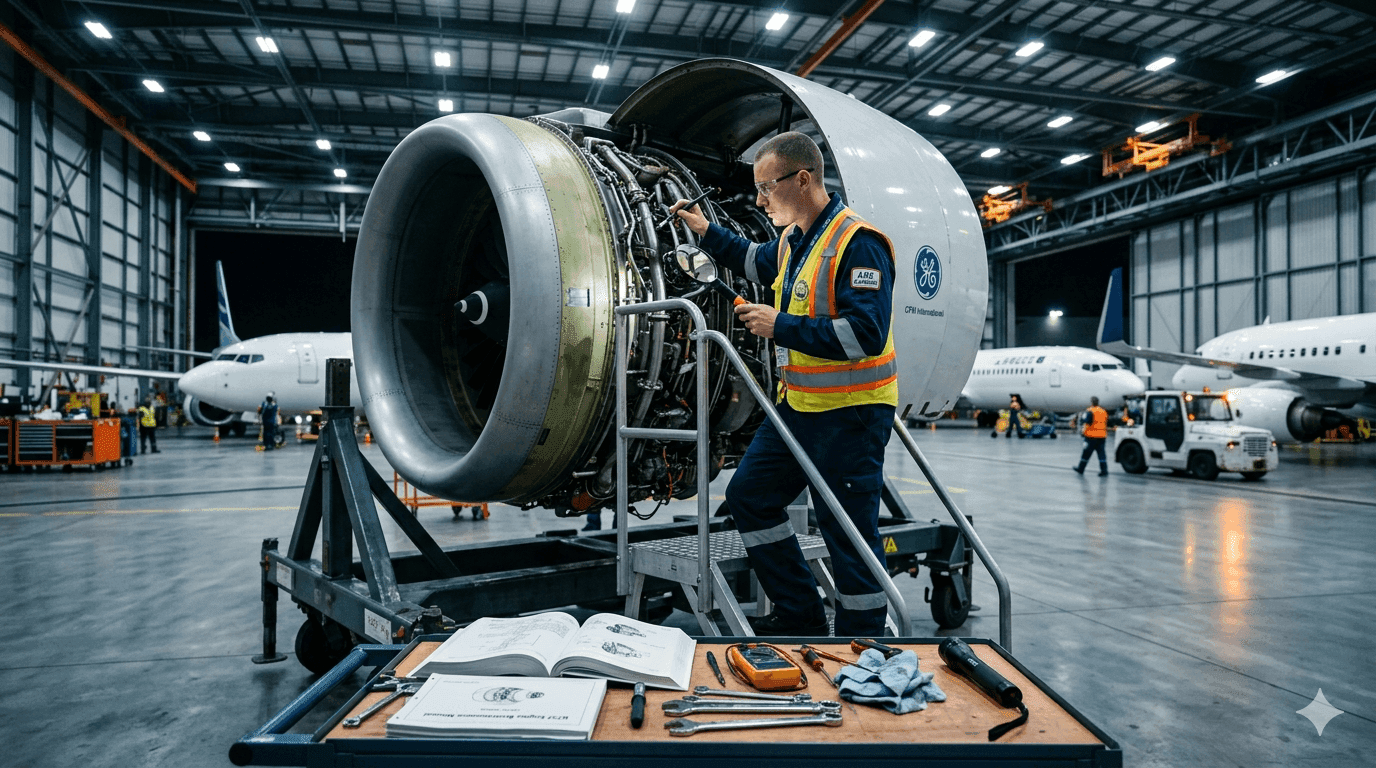


Aircraft Maintenance Engineers are the unsung backbone of aviation safety. While pilots operate aircraft and cabin crew manage passengers, it is the AME who certifies every aircraft as airworthy before a single passenger boards. In India, the AME profession is governed by DGCA under CAR-66 regulations — a structured, module-based licensing framework that places AMEs among the most technically qualified professionals in aviation.
India's growing fleet — with airlines like IndiGo, Air India, and SpiceJet expanding aggressively — has created sustained demand for licensed AMEs. MRO (Maintenance, Repair & Overhaul) facilities are expanding in Hyderabad, Bengaluru, and Delhi, and the government's push for domestic MRO growth means this is an excellent time to enter the field.
Whether you are a science student evaluating aviation careers, or a working professional considering a technical aviation pathway, this guide covers everything: the role, CAR-66 license categories, modules, eligibility, experience requirements, career growth, and salary expectations.
Need personalised guidance on AME careers? Book a free career consultation with our aviation experts before you apply. 👉 Get Free Career Consultation
1. What is an Aircraft Maintenance Engineer (AME)?
An Aircraft Maintenance Engineer is a licensed professional authorised to certify aircraft as airworthy after maintenance, inspection, or repair work. The AME's signature — issued as a Certificate of Release to Service (CRS) — is the final legal clearance that allows an aircraft to fly.
Without a licensed AME's certification, no commercial aircraft can depart. This makes the AME role one of the most legally critical positions in civil aviation.
"An AME's signature on a CRS is the last line of defence before an aircraft enters service. That signature represents technical knowledge, professional judgement, and personal accountability." — Senior MRO Quality Manager
Core Responsibilities:
- Inspect, maintain, and repair aircraft structures, systems, and engines
- Diagnose technical defects and perform troubleshooting
- Carry out scheduled and unscheduled maintenance tasks
- Complete technical documentation and maintenance records
- Issue the Certificate of Release to Service (CRS) upon completion
- Ensure all work complies with the Approved Maintenance Organisation (AMO) procedures and DGCA regulations
2. What is CAR-66?
CAR-66 is the DGCA Civil Aviation Requirement that defines the regulatory framework for AME licensing in India. It is modelled on the European EASA Part-66 framework and specifies:
- License categories and sub-categories
- Modular examination syllabus and structure
- Minimum experience requirements for each license type
- Privileges and limitations of each license category
- Knowledge and competency standards for certification
CAR-66 replaced the older Indian AME licensing system and brought India's framework closer to international standards, making Indian-licensed AMEs more globally competitive.
📖 Career Roadmap for the Aspiring Commercial Pilot 📖 How to Apply for Aviation Courses in India
3. AME License Categories Under CAR-66
CAR-66 defines five main license categories. Each corresponds to a specific type of maintenance work and aircraft type:
| Category | Scope |
|---|---|
| Category A | Line Maintenance — authorises routine pre-flight and transit checks under the supervision of a B-category licence holder |
| Category B1 | Mechanical systems — authorises maintenance and certification of aircraft structures, engines, and mechanical/electrical systems |
| Category B2 | Avionics — authorises maintenance and certification of avionics, electrical, and instrument systems |
| Category B3 | Small non-pressurised piston-engine aircraft below 2,000 kg MTOW |
| Category C | Base Maintenance — authorises the issue of CRS for entire aircraft following base/hangar maintenance checks |
B1 Sub-Categories:
- B1.1 — Turbine-engine aeroplanes (commercial airliners)
- B1.2 — Piston-engine aeroplanes
- B1.3 — Turbine-engine helicopters
- B1.4 — Piston-engine helicopters
The majority of AME aspirants in India target B1.1 (commercial jet aircraft) or B2 (avionics), as these align with the largest employer segments — scheduled airlines and MROs.
4. Eligibility Criteria
Most DGCA-approved AME training institutes follow the standard CAR-66 eligibility profile:
- Educational Qualification: Minimum 10+2 with Physics, Chemistry, and Mathematics from a recognised board
- Minimum Age: 18 years at the time of training enrolment
- Language Proficiency: English proficiency is mandatory — technical documentation, maintenance manuals, and regulatory communication are all in English
- Medical Fitness: Good eyesight and physical fitness to work in aircraft bays, hangars, and confined spaces
Note: Students from a PCM background (Physics, Chemistry, Mathematics) are strongly preferred. Some institutes also accept diploma holders in mechanical or electrical engineering with relevant subjects.
5. CAR-66 Examination Modules
CAR-66 examinations are modular — candidates must pass individual modules rather than a single comprehensive exam. This allows candidates to progress at their own pace.
Core Modules (All Categories)
| Module | Subject |
|---|---|
| Module 1 | Mathematics |
| Module 2 | Physics |
| Module 3 | Electrical Fundamentals |
| Module 4 | Electronic Fundamentals |
| Module 5 | Digital Techniques / Instrument Systems |
| Module 6 | Materials and Hardware |
| Module 7A | Maintenance Practices |
| Module 8 | Aerodynamics / Structures |
| Module 9 | Human Factors |
| Module 10 | Aviation Legislation |
Category B1 — Additional Modules
| Module | Subject |
|---|---|
| Module 11 | Aeroplane Aerodynamics, Structures and Systems |
| Module 15 | Gas Turbine Engine |
Category B2 — Additional Modules
| Module | Subject |
|---|---|
| Module 13 | Aircraft Aerodynamics, Structures and Systems (Avionics focus) |
| Module 14 | Propulsion (basic awareness) |
Exam Format:
- MCQ-based objective examination
- Passing threshold: 75% in each module
- Modules have a validity period — candidates must complete all required modules within the prescribed timeframe to remain eligible for licensing
📖 DG_CA AME CAR-66 Exam Syllabus: Modules, Categories & Tips_
6. Experience Requirements
Passing the CAR-66 modules is necessary but not sufficient for licensing. Candidates must also accumulate approved practical experience working in a licensed AMO (Approved Maintenance Organisation).
| License Category | Minimum Experience |
|---|---|
| B1.1 / B2 | 5 years of approved maintenance experience |
| B1.2 / B3 | 3 years of approved maintenance experience |
| Category A | 3 years (with further restrictions on CRS privileges) |
"The experience requirement exists because technical knowledge alone is not enough. AMEs must develop sound mechanical judgment, troubleshooting instinct, and the ability to make airworthiness decisions under operational pressure." — DGCA AME Examiner
Experience must be documented in an approved logbook and verified by the AMO's Quality Manager before a license application is submitted to DGCA.
7. Privileges of a Licensed AME
Once licensed, an AME is authorised to exercise specific certification privileges:
- Issue a Certificate of Release to Service (CRS) — the legal clearance that returns an aircraft to service following maintenance
- Certify maintenance work within the scope of their license category and type ratings
- Supervise Category A licence holders during line maintenance tasks
These privileges are limited to the aircraft types for which the AME holds a valid type rating, and are exercised within the framework of the AMO's procedures and DGCA regulations.
8. Essential Skills for an AME
Beyond technical knowledge and modules, employers and examiners look for specific professional qualities:
- Technical Precision: AME work has zero tolerance for error — attention to detail is non-negotiable
- Problem-Solving: Diagnosing aircraft defects requires structured, methodical troubleshooting capability
- Documentation Discipline: Every task must be recorded accurately; poor documentation is a regulatory violation
- Situational Awareness: Understanding the broader maintenance context — what flight is next, what pressure exists — and maintaining safety regardless
- Communication: Coordinating with engineering, operations, and flight crew requires clear verbal and written communication
- Physical Stamina: Maintenance work involves working in confined spaces, at height, in hangars, and during night shifts
"The best AMEs are not just technically sound — they are disciplined, meticulous, and they never take shortcuts. Aviation does not forgive shortcuts." — Chief of Maintenance, Indian MRO Facility
9. Career Growth for AMEs
A licensed AME career follows a structured technical and managerial progression:
- Trainee / Apprentice — hands-on experience at an AMO during the pre-licensing phase
- Licensed AME (B1/B2/C) — certifying maintenance work within scope
- Type Rated AME — additional aircraft type ratings (e.g., B737, A320) expand certification privileges significantly
- Senior AME / Lead Engineer — team lead for maintenance shifts or specialist systems
- Quality Inspector / Quality Auditor — internal quality assurance within the AMO
- Maintenance Manager / Director of Maintenance — operations and regulatory management
- DGCA Authorised Inspector / Designated Examiner — regulatory and examination roles
Experienced AMEs also transition into airworthiness consultancy, regulatory roles at DGCA, and aviation training as module instructors.
10. Salary Expectations
| Career Stage | Monthly Salary (India) |
|---|---|
| Trainee / Pre-licence | ₹15,000 – ₹30,000 |
| Newly Licensed AME | ₹50,000 – ₹80,000 |
| Experienced Licensed AME | ₹80,000 – ₹1.5 lakhs |
| Senior / Type-Rated AME | ₹1.5 – ₹2.5 lakhs |
| Maintenance Manager | ₹2 lakhs and above |
International Opportunity: Licensed AMEs with B1.1/B2 ratings and type ratings on commercial aircraft types (A320, B737) are in high demand at Middle East, Southeast Asian, and European MROs. International packages often range from USD 3,000 – USD 6,000+ per month depending on location and experience.
11. Career Opportunities — Where Do AMEs Work?
- Scheduled Airlines: IndiGo, Air India, SpiceJet, Vistara, Akasa Air (maintenance departments and line stations)
- MRO Organisations: Air India Engineering Services, Air Works, Lufthansa Technik (India), GMR Aero Technic
- Defence / Government: IAF civilian MRO, HAL (Hindustan Aeronautics Limited), AAI
- General Aviation: Charter operators, helicopter operators, private aviation companies
- Manufacturing: Aerospace component manufacturers and OEM support centres
- International Airlines and MROs: Etihad, Emirates Engineering, SIA Engineering, and others recruit Indian-licensed AMEs
Is an AME Career Right for You?
Not everyone is suited to the technical, high-responsibility demands of an AME career. Here's a quick comparison to help you decide:
| Factor | AME (B1/B2) | Commercial Pilot | Cabin Crew |
|---|---|---|---|
| Minimum Education | 10+2 (PCM) | 10+2 (PCM) | 10+2 (any stream) |
| Training Duration | 2–4 years | 18–24 months | 3–6 months |
| Estimated Cost | ₹4 – ₹10 lakhs | ₹25 – ₹45 lakhs | ₹50K – ₹2 lakhs |
| Starting Salary | ₹15,000 – ₹30,000 (trainee) | ₹1 – ₹1.5 lakhs | ₹25,000 – ₹45,000 |
| Key Requirement | PCM + technical aptitude | DGCA exams + flight hours | Grooming + fitness |
Not sure whether AME, pilot, or another aviation career is the right fit for your profile? Our aviation counsellors can help you evaluate your strengths, budget, and long-term goals. 👉 Get Free Career Consultation — No Cost, No Obligation
What to Do Next
- Confirm your 10+2 eligibility with Physics, Chemistry, and Mathematics
- Research DGCA-approved AME training institutes in your city
- Understand the CAR-66 module structure and plan your examination pathway
- Identify airlines and MROs where you can fulfil your experience requirement
- Book a free consultation to get personalised advice on institutes and career planning
Your AME career starts with one decision — and we're here to make sure it's the right one.