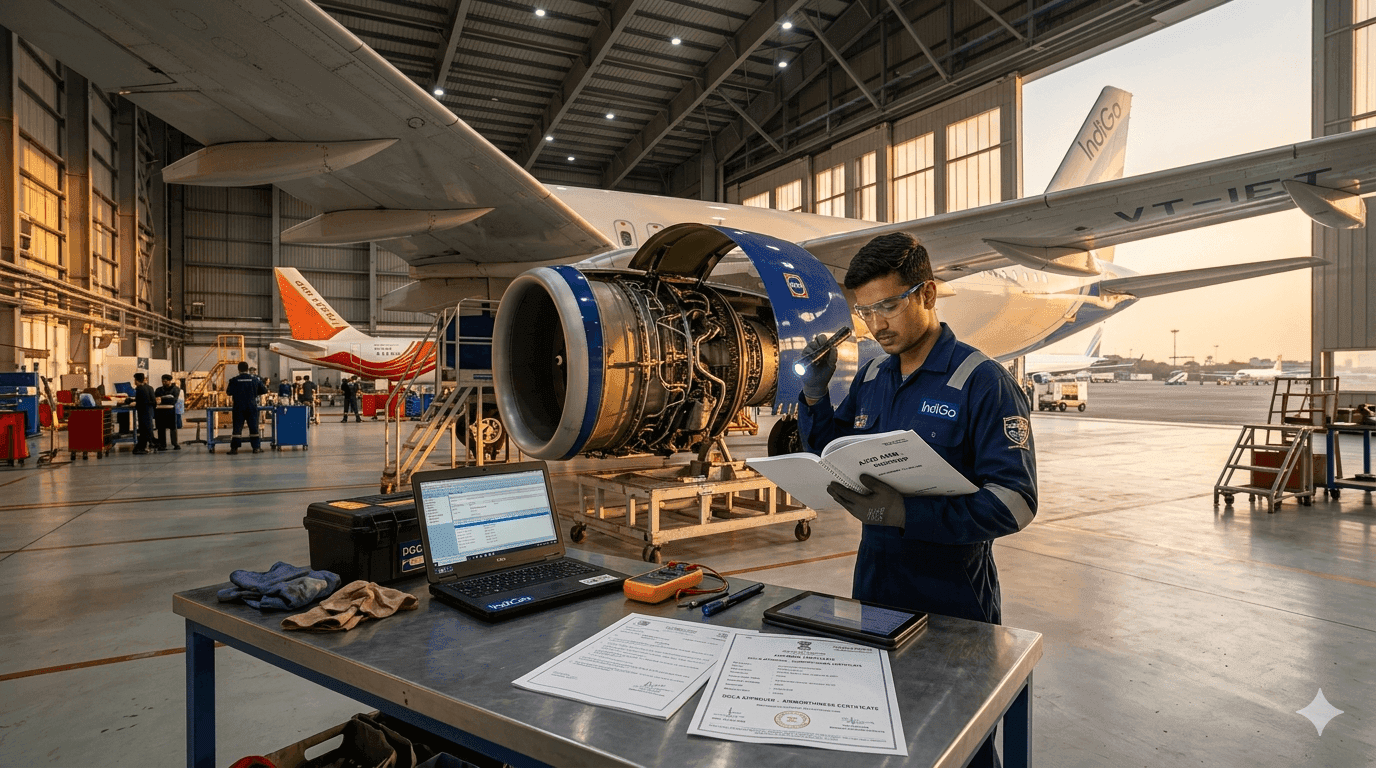


India's aviation maintenance sector is one of the fastest-growing in the region. With airlines expanding fleets, MRO facilities scaling up, and the DGCA tightening regulatory standards, qualified AMEs are in high demand. Whether your goal is to maintain wide-body jets, fix avionics systems, or service piston-engine aircraft — the DGCA AME licensing pathway is your gateway to a stable, well-respected career in aviation.
This guide covers everything you need to know about the DGCA CAR-66 AME examination system: the module-wise syllabus, category requirements, study strategy, and the full licensing path from exam clearance to aircraft type rating.
Need guidance on your AME career path?
Book a free career consultation with our aviation experts before you enrol.
1. Exam Overview
AME licensing examinations are conducted by DGCA under Civil Aviation Requirement (CAR) Module 66. The exam structure is designed to test both theoretical knowledge and practical understanding across a modular framework.
Key exam details at a glance:
• Format: Multiple Choice Questions (MCQ)
• Passing threshold: 75% in each module
• No negative marking
• Modular system — modules can be attempted independently, giving candidates flexibility to schedule preparation
• Examinations are conducted at DGCA-approved Computer Based Test (CBT) centres across India
"The AME licence is not just an exam — it is a regulatory credential that carries direct responsibility for aircraft airworthiness. Treat each module with the seriousness it deserves."
— Senior AME, Indian MRO industry
2. Module-Wise Syllabus
DGCA CAR-66 follows the EASA Part-66 framework with India-specific regulatory modules added (primarily Module 10). The full module list applicable to AME licensing in India is outlined below:
| Module | Topics Covered |
| Module 1 | Arithmetic, Algebra, Geometry, Trigonometry, Graphs |
| Module 2 | Mechanics, Thermodynamics, Optics, Electricity, Waves & Sound |
| Module 3 | DC/AC Circuits, Transformers, Electrical Machines |
| Module 4 | Semiconductors, Diodes, Transistors, Integrated Circuits |
| Module 5 | Binary Systems, Logic Gates, Microprocessors, Fibre Optics |
| Module 6 | Aircraft Materials, Corrosion, Fasteners, Pipes & Unions |
| Module 7 | Tools, Safety, Inspection Techniques, NDT Methods |
| Module 8 | Lift, Drag, Thrust, Stability, Flight Controls |
| Module 9 | Fatigue, Stress, Human Error, CRM, Safety Culture |
| Module 10 | CAR Regulations, DGCA Rules, SMS, Airworthiness |
| Module 11A/B | Turbine / Piston Aeroplane Systems (B1 Category) |
| Module 12 | Helicopter Systems — Turbine / Piston (B1 Category) |
| Module 13 | Aircraft Aerodynamics, Structures & Systems (B2) |
| Module 15 | Gas Turbine Engines |
| Module 16 | Piston Engines |
| Module 17 | Propellers |
Note: Module 14 is not listed above as it is not currently part of the active DGCA CAR-66 examination schedule for India.
3. Category-Specific Modules
Under CAR-66, an AME licence is issued for a specific aircraft category. The two primary categories are B1 (Mechanical/Airframe) and B2 (Avionics). Each category has its own mandatory module set.
Category B1 — Mechanical (Airframe & Powerplant)
B1 is the most widely pursued AME category in India, covering the mechanical systems of both fixed-wing and rotary-wing aircraft.
• Core subjects: Aircraft structures and systems
• Engines: Gas turbine and piston engines (Modules 15 and 16)
• Propellers (Module 17)
• Additional: Modules 6, 7, 8, 9, 10, 11A/B (aeroplane) or 12 (helicopter)
Category B2 — Avionics
B2 covers the electronic, electrical, and instrument systems of aircraft. It is increasingly relevant given the sophistication of modern avionics suites.
• Avionics and instrument systems (Module 13)
• Communication and navigation systems (Module 5)
• Electrical power systems (Module 3)
• Electronic fundamentals: semiconductors, transistors, integrated circuits (Module 4)
Quick category comparison:
| Factor | Category B1 (Mechanical) | Category B2 (Avionics) |
| Focus Area | Aircraft structures, engines, systems | Avionics, instruments, navigation |
| Key Modules | M6, M7, M8, M11A/B, M15, M16, M17 | M3, M4, M5, M13 |
| Engine Type | Gas turbine and piston engines | Not applicable |
| Career Scope | Maintenance of airframe & powerplant | Maintenance of avionics & electrical systems |
| Typical Employer | Airlines, MROs, charter operators | Airlines, MROs, avionics firms |
4. Study Strategy
Clearing DGCA AME exams requires disciplined, module-by-module preparation. The following approach has been validated by working AMEs and training institutes:
1. Prioritise Module 10 (Aviation Legislation) — This module carries high weightage across all categories and is a regulatory requirement. Start here.
2. Practice MCQs daily from DGCA previous question banks — Pattern recognition across past papers is critical for the MCQ format.
3. Give special focus to Module 9 (Human Factors) — Frequently tested and conceptually important for airworthiness culture.
4. Use EASA Part-66 study material as a supplementary reference — The EASA framework underpins DGCA CAR-66 and offers comprehensive coverage.
5. Attempt mock tests module-wise before consolidating into full exam preparation — Isolate weak areas early.
6. Revise Modules 6 and 7 (Materials and Tools) thoroughly — These are foundation modules that support understanding across other technical subjects.
7. For B2 candidates: ensure strong mathematical fundamentals from Module 1 — Avionics modules build heavily on electrical theory.
"Most AME exam failures happen because students try to cover everything at once. Module by module, with daily MCQ practice — that is the method that works."
— AME Training Faculty, DGCA-approved institute
Related Reads
📖 Best Books for DGCA CPL Exams 2026
📖 How to Clear DGCA Exams in First Attempt
5. Licensing Path — From Exam to Licence
Clearing the DGCA module examinations is only the first step. The full AME licensing pathway under CAR-66 is as follows:
8. Clear all required DGCA module examinations for your chosen category (B1 or B2).
9. Complete On-the-Job Training (OJT) at a DGCA-approved Approved Maintenance Organisation (AMO) — minimum duration as specified under CAR-66 for your sub-category.
10. Accumulate minimum practical experience as per CAR-66 requirements (generally 3 years for B1/B2 with a recognised apprenticeship).
11. Apply for your AME Licence with DGCA through the eGCA portal, along with all supporting documentation.
12. Obtain Aircraft Type Rating for the specific aircraft type(s) you will be authorised to certify — this is issued by DGCA after type-specific training at an approved organisation.
Note: The specific experience hours required may vary based on whether you hold a recognised aeronautical engineering qualification. Refer to the latest version of CAR-66 on the DGCA website for current thresholds.
Typical timeline: 2–4 years from first module attempt to receiving your AME licence, depending on exam pace and OJT availability.
Not Sure Which Category is Right for You?
Choosing between B1 (Mechanical) and B2 (Avionics) depends on your academic background, interests, and long-term career goals. If you have a strong foundation in mathematics and electronics, B2 may suit you well. If you prefer hands-on mechanical work and engines, B1 is the traditional path.
If you're unsure, our aviation career counsellors can help you assess your eligibility, select the right category, and identify the right AME training institute.
Need guidance on your AME career path?
Book a free career consultation with our aviation experts before you enrol.
👉 Get Free Career Consultation
What to Do Next
13. Decide your category (B1 or B2) using the comparison table above.
14. Register on the DGCA eGCA portal to obtain your Computer Number — required before appearing for any DGCA exam.
15. Identify and enrol at a DGCA-approved AME training institute.
16. Read the detailed module syllabi and start with Module 10 and your category-core modules.
17. Book a free consultation to get personalised advice on institutes, study material, and exam scheduling.
Your AME career starts with one step — and we're here to make sure it's the right one. Contact us for free guidance today.