
Before a single flying hour counts toward your licence, you have to clear a set of prerequisites the DGCA (Directorate General of Civil Aviation) sets for every category of pilot licence — Student Pilot Licence (SPL), Private Pilot Licence (PPL), and Commercial Pilot Licence (CPL). These prerequisites cover four things: your age, your educational qualification, your medical fitness, and the paperwork you'll need to register with the DGCA's Pariksha portal.
This guide walks through each prerequisite in the order you'll actually need to clear it, from "can I even apply" to "what do I hand the admissions desk on day one." If you're comparing pilot training against other aviation careers — cabin crew, AME, ground staff — see our Aviation Course Eligibility Criteria guide instead; this article is specifically about the flight-school/pilot licence pathway. And once you've confirmed you're eligible, the next question is almost always cost — see Pilot Training Cost in India 2026: Real CPL Fees Breakdown | Apano Aviation for verified rate cards and a full fee breakdown.
At a Glance: Prerequisites by Licence Type
| Requirement | SPL | PPL | CPL |
|---|---|---|---|
| Minimum age | 16 years | 17 years | 18 years (training can start at 17) |
| Education | Class 10 pass | See note below — sources conflict | Class 12 (10+2) with Physics & Mathematics |
| Medical certificate | DGCA Class 2 | DGCA Class 2 | DGCA Class 2 (initially), DGCA Class 1 before licence issue |
| Governing framework | Aircraft Rules 1937, Schedule II; CAR Section 7 | Aircraft Rules 1937, Schedule II; CAR Section 7 | Aircraft Rules 1937, Schedule II; CAR Section 7 |
Note: the Airline Transport Pilot Licence (ATPL) — the licence airlines require for captaincy — has a minimum age of 21 and is pursued after CPL, not as a starting point.
⚠️ Accuracy note on PPL education requirement: Sources genuinely conflict here. The DGCA's own Pariksha portal user manual states only a 10th-standard certificate is required for PPL examination candidates, while several secondary sources state 10+2 with Physics and Maths is required — the same standard as CPL. We're flagging this rather than picking one arbitrarily. Confirm your exact eligibility with your chosen FTO or directly with your DGCA regional office before assuming either standard applies to you.
Step 1: Meet the Educational Qualification
For a Commercial Pilot Licence (CPL) — the licence most aspiring professional pilots are working toward — DGCA requires:
- Class 12 (10+2) pass from a recognised board (CBSE, ICSE, or a state board), with Physics and Mathematics as subjects.
- DGCA does not prescribe a minimum percentage for CPL eligibility itself, though most flying schools informally expect 50%+ aggregate, since weak Physics/Maths fundamentals make the DGCA ground exams (especially Air Navigation and Technical General) harder to clear.
- Commerce and Arts stream students are not excluded. If you didn't take Physics and Maths in Class 12, you can clear them separately through NIOS (National Institute of Open Schooling) and still qualify — this is a recognised, commonly used pathway, not a workaround.
- A three-year Diploma in Engineering (Polytechnic) after Class 10 that includes both Physics and Maths is also accepted as equivalent — but get this equivalence confirmed by the DGCA directly, not just by the school, before paying any admission deposit.
For SPL, a Class 10 pass is the stated requirement.
For PPL, see the accuracy flag above — verify directly rather than relying on any single source, including this one, until it's resolved against the primary CAR text.
Step 2: Check the Age Requirement for Your Target Licence
- SPL: 16 years (most sources agree on this; a small number cite 16.5 — treat 16 as the reliable figure but don't be surprised if an individual FTO's entrance process uses a slightly different internal cutoff).
- PPL: 17 years at the time of licence issue.
- CPL: 18 years at the time of licence issue — but you can begin flight training and hold an SPL/PPL from age 16–17, so the training clock can start well before you turn 18.
- ATPL: 21 years minimum — this comes after CPL, once you're building hours toward an airline career.
- There is no DGCA-mandated upper age limit to start pilot training, though a CPL itself is only valid for exercising professional flying privileges up to age 65, and airlines commonly have their own hiring-age preferences.
Step 3: Clear Your DGCA Medical Certification
Medical fitness is arguably the single most important — and most irreversible — prerequisite, because unlike a weak exam score, a medical disqualification can end the pathway outright. Get this checked before you spend money on anything else.
- DGCA Class 2 Medical Certificate — required before you register for ground classes / the Pariksha portal, and before starting flight training. Covers general fitness, vision, hearing, ECG, and other baseline checks conducted by a DGCA-approved medical examiner.
- DGCA Class 1 Medical Certificate — a more rigorous standard required before your CPL is actually issued. You don't need Class 1 to start training, but you do need it before DGCA will hand you the licence.
- Both certificates have validity periods and must be kept current through your training; letting one lapse can delay your exam eligibility.
- Get your Class 2 Medical done first, before enrolling anywhere — it's the cheapest way to find out early if there's a disqualifying condition, rather than discovering it after paying admission fees.
Step 4: Meet the English Language Requirement
All ground instruction, radio communication, and cockpit documentation in Indian commercial aviation are in English. DGCA requires:
- A basic English-language pass at the 10+2 level (typically around a 33% language-subject pass, not a separate proficiency exam at this stage).
- ICAO Level 4 English proficiency is required later, for the actual licence endorsement — this is tested separately and is a standard international aviation requirement, not something specific to India.
Step 5: Choose a DGCA-Approved Flying School
This is where prerequisites shift from "can I apply" to "where do I apply." Before enrolling anywhere:
- Confirm the institute is a genuine DGCA-approved Flying Training Organisation (FTO). Training hours logged at a non-approved school will not count toward your CPL.
- Check the official DGCA list of approved FTOs directly on the DGCA portal rather than relying solely on a school's own claim.
- Ask about aircraft-to-student ratio, instructor availability, and simulator access — these affect how long your 200 flying hours actually take to complete in practice, even though they're not DGCA prerequisites per se. Once you've shortlisted a school, budget honestly — see Pilot Training Cost in India 2026: Real CPL Fees Breakdown | Apano Aviation for verified per-hour rates across government and private institutes, since the hourly rate is the single biggest variable in your total cost.
Step 6: Register on the DGCA Pariksha Portal & Get a Computer Number
Before you can sit any DGCA theory exam, you need a DGCA Computer Number, issued through the DGCA Pariksha portal. This is typically one of the first administrative steps once your medical and educational documents are in order — many FTOs assist students with this filing to avoid document-rejection delays.
Step 7: Gather Your Documents
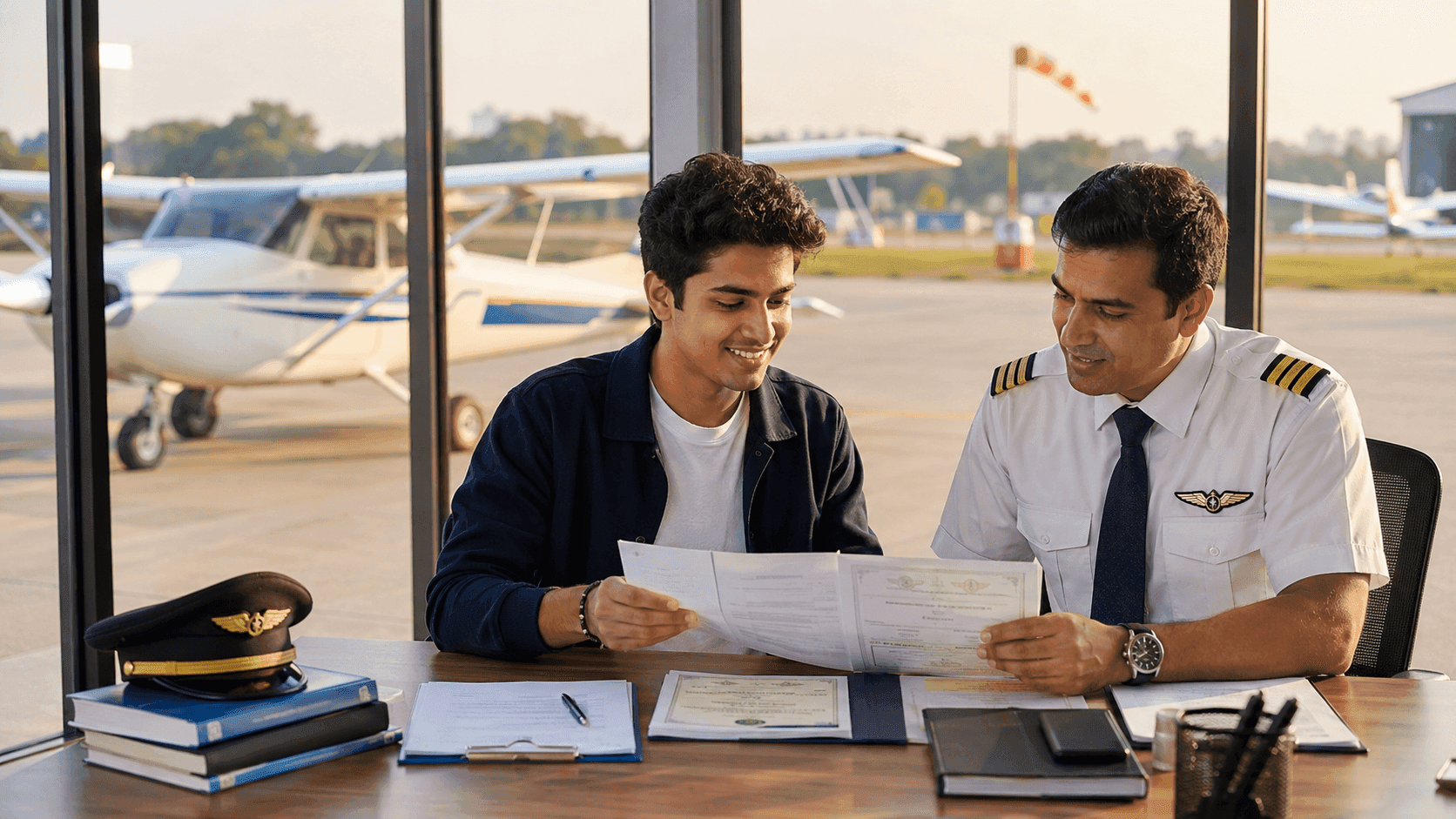
Based on the Pariksha portal's own documentation requirements, keep the following ready:
- Class 10 certificate and mark sheet (required for all pilot exam categories, including PPL/CPL/ATPL)
- Class 12 certificate and mark sheet with Physics & Mathematics (for CPL)
- Proof of age (birth certificate or equivalent, issued by a municipal authority or accepted government body)
- Valid photo ID
- DGCA Class 2 Medical Certificate
- Recent passport-size photographs
- If applicable: NIOS certificates (Physics/Maths), Diploma equivalence letter, or name-change documentation (marriage certificate, gazette notification) if your ID names don't match across documents
Step 8: Enroll and Begin Ground School
Once documents, medical, and Computer Number are in place, enrollment and ground school (covering Air Navigation, Air Regulations, Aviation Meteorology, Technical General, and Technical Specific) typically begins. This is where the actual training timeline — separate from the admission prerequisites covered in this guide — starts.
🎯 Not sure which licence path fits your goals? Talk to our aviation career experts — completely free.
Common Reasons Applications Get Delayed or Rejected
- Missing Physics or Mathematics in Class 12 with no NIOS completion on file
- Medical certificate expired or not from a DGCA-approved examiner
- Mismatched names across ID documents without supporting change-of-name paperwork
- Enrolling at a school before confirming its DGCA-approved status
Sources: Aircraft Rules, 1937 — Schedule II; DGCA Civil Aviation Requirements (CAR), Section 7 — Flight Crew Standards, Training and Licensing; DGCA Pariksha Portal. Cross-referenced against multiple currently published guides for consistency; discrepancies between secondary sources are flagged above rather than silently resolved.