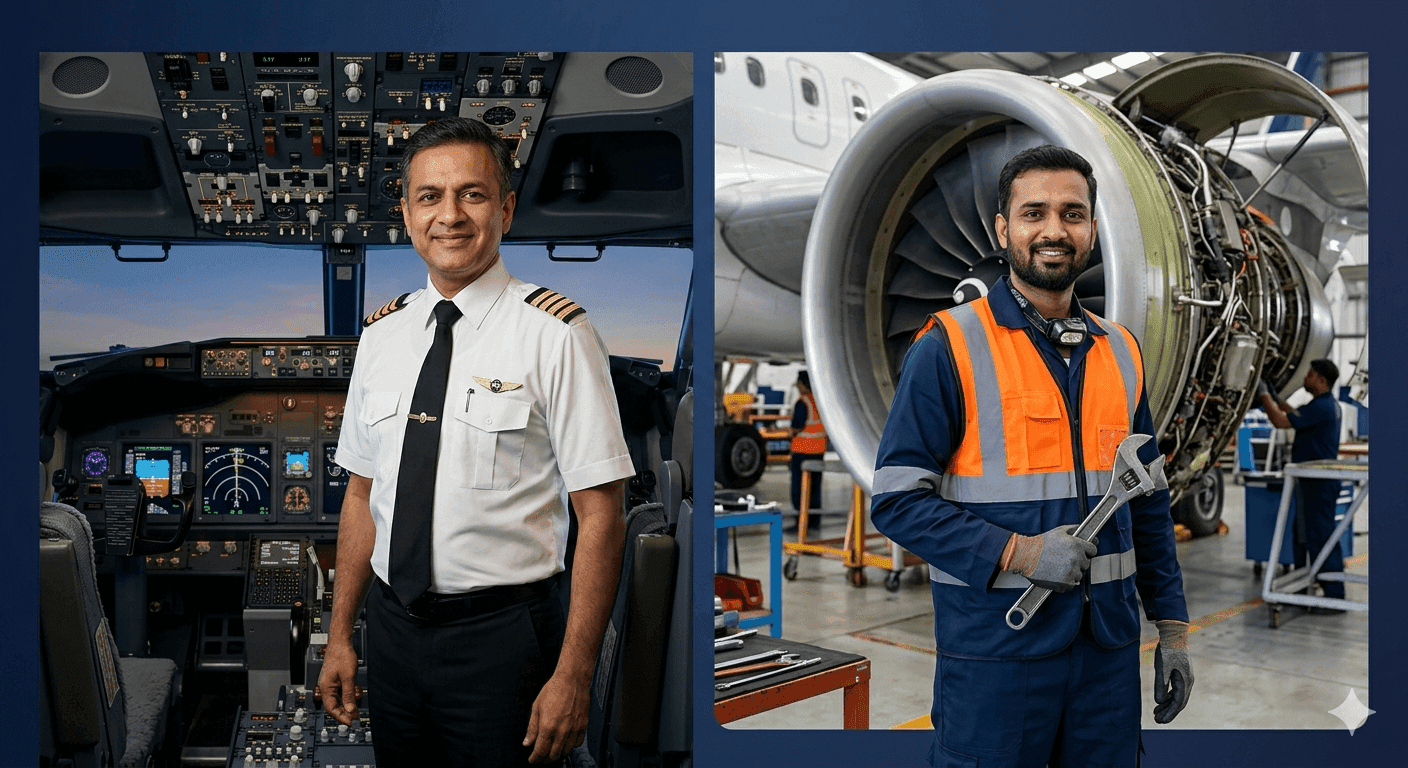



Choosing a career in aviation is a dream for thousands of students across India every year. Two of the most popular and respected career paths in this industry are becoming a Commercial Pilot or an Aircraft Maintenance Engineer (AME). Both roles are essential to the functioning of any airline — one flies the aircraft, the other ensures it is safe to fly.
However, they differ significantly in training investment, daily responsibilities, career trajectory, lifestyle, and risk profile. This guide breaks down both careers in detail so you can make an informed decision based on your interests, budget, and long-term goals.
📞 Not Sure Which Aviation Career Is Right for You?
Book a free consultation with our aviation experts. We'll help you evaluate your profile, budget, and interests to find the best-fit career path.
1. Understanding the Role of a Pilot
A commercial pilot is responsible for safely operating an aircraft from one destination to another. This includes pre-flight checks, navigation planning, communication with Air Traffic Control (ATC), in-flight decision-making, and handling emergencies. Pilots carry the ultimate responsibility for the lives of everyone on board.
Key Responsibilities:
- Pre-flight planning, weather briefing, and route analysis
- Operating the aircraft in compliance with DGCA regulations and airline SOPs
- Communicating with ATC during all phases of flight
- Managing fuel, systems, and in-flight emergencies
- Coordinating with cabin crew and co-pilot throughout the flight
Training Path to Become a Pilot in India
The standard pathway to becoming a commercial pilot in India involves the following steps:
- Educational Qualification: 10+2 with Physics and Mathematics (minimum 50% aggregate)
- Medical Certification: DGCA Class 2 Medical followed by Class 1 Medical
- Flying Training: Minimum 200 hours of flying at a DGCA-approved FTO
- DGCA Ground Exams: Clear all CPL theory subjects — Navigation, Meteorology, Technical General, Technical Specific, Air Regulation
- CPL Licence: Issued by DGCA after meeting all flying hour, exam, and medical requirements
- Type Rating: Aircraft-specific training (e.g., A320, B737) required before joining an airline
Cost of Becoming a Pilot
- Without Type Rating: ₹45–70 lakh (FTO fees, ground school, accommodation, exam fees)
- With Type Rating: ₹80 lakh–₹1.2 crore (including airline-specific aircraft training)
Pilot Salary in India
- Fresher / Junior First Officer: ₹1.5–3 lakh per month
- Senior First Officer (3–5 years): ₹3–5 lakh per month
- Captain (8–12 years): ₹6–10 lakh per month
- Senior Captain / Wide-body: ₹10–20+ lakh per month
“The pilot career has one of the highest salary ceilings in India — but it also demands the highest upfront investment. ROI depends on how quickly you secure your first airline job after training.”
2. Understanding the Role of an AME
An Aircraft Maintenance Engineer (AME) is responsible for inspecting, maintaining, and certifying aircraft as airworthy before every flight. AMEs work on the ground, handling everything from routine servicing to complex component overhauls. They are licensed professionals whose certification stamp (CRS — Certificate of Release to Service) is legally required before any aircraft can take off.
Key Responsibilities:
- Performing scheduled and unscheduled maintenance checks on aircraft
- Diagnosing and repairing mechanical, electrical, and avionics systems
- Issuing the CRS (Certificate of Release to Service) — a legal clearance for flight
- Maintaining maintenance logs and compliance with DGCA CAR-66 standards
- Coordinating with Quality and Engineering departments of the airline or MRO
Training Path to Become an AME in India
- Educational Qualification: 10+2 with Physics, Chemistry, and Mathematics (PCM)
- AME Course: 3-year programme at a DGCA-approved AME institute (4 semesters of theory + practical training)
- DGCA Module Exams: Clear all required CAR-66 module examinations
- Practical Experience: Minimum prescribed months of on-the-job training (OJT) at an airline or MRO
- AME Licence: Issued by DGCA after completing all modules and practical requirements
Cost of Becoming an AME
- Total Course Fee: ₹8–20 lakh (varies by institute — includes tuition, hostel, and exam fees)
- Additional Costs: ₹1–3 lakh (tools, travel for OJT, exam retake fees if applicable)
AME Salary in India
- Fresher / Trainee AME: ₹25,000–₹60,000 per month
- Licensed AME (3–5 years): ₹80,000–₹1.5 lakh per month
- Senior AME / Base Maintenance (7–10 years): ₹1.5–3 lakh per month
- Chief Engineer / Quality Manager: ₹3–5 lakh per month
“The AME career offers a stable, ground-based aviation career with predictable growth. The investment is significantly lower than piloting, making it accessible to a much wider pool of aspirants.”
3. Head-to-Head Comparison: Pilot vs AME
| Factor | Pilot | AME |
|---|---|---|
| Training Cost | ₹45 lakh–₹1.2 crore | ₹8–20 lakh |
| Training Duration | 2–3 years (flying + exams) | 3–4 years (course + OJT) |
| Licensing Authority | DGCA CPL | DGCA CAR-66 AME Licence |
| Starting Salary | ₹1.5–3 lakh/month | ₹25,000–₹60,000/month |
| Senior-Level Salary | ₹6–20+ lakh/month | ₹1.5–5 lakh/month |
| Work Environment | Cockpit — in the air | Hangar / Tarmac — on the ground |
| Lifestyle | Irregular hours, travel, layovers | Shift-based, stable routine |
| Job Risk | High investment, competitive entry | Lower risk, steady demand |
| Global Opportunities | High (ICAO CPL recognised worldwide) | High (CAR-66 / EASA convertible) |
| Career Ceiling | Very high (Captain / Chief Pilot) | High (Chief Engineer / VP MRO) |
4. Lifestyle and Work-Life Balance
Pilot Lifestyle
Pilots live a fast-paced lifestyle that revolves around flight rosters. Schedules are irregular — early mornings, late nights, weekends, and holidays are all part of the job. Domestic pilots may spend 2–3 nights away from home per week, while international pilots can be away for longer stretches. The lifestyle comes with perks — travel, layover allowances, and airline benefits — but demands personal discipline and adaptability.
AME Lifestyle
AMEs work in shift-based schedules at airline hangars, airport maintenance bays, or MRO facilities. The work is physically demanding and involves night shifts, but the schedule is more predictable than a pilot's. AMEs typically return home after each shift and have a more stable routine, making it easier to maintain personal and family commitments.
5. Career Growth and Long-Term Prospects
Pilot Career Trajectory
Junior First Officer → Senior First Officer → Captain → Senior Captain → Training Captain / Check Pilot → Chief Pilot / Fleet Manager
The progression is structured and largely seniority-based within airlines. Captaincy typically takes 8–12 years depending on airline expansion and fleet growth. Wide-body upgrades and international routes command the highest pay.
AME Career Trajectory
Trainee AME → Licensed AME (Line Maintenance) → Base Maintenance Engineer → Quality Inspector → Shift-in-Charge → Chief Engineer → VP Engineering / MRO Head
AMEs can also branch into specialised roles — avionics, composites, engine overhaul — or move into regulatory and quality assurance positions with DGCA or international aviation bodies.
"Both careers have strong long-term prospects in India. With over 1,000 new aircraft on order by Indian carriers and MRO capacity expanding, demand for both pilots and AMEs will remain robust through at least 2035."
📖 FTO Fees in India — Complete Guide 2026
6. Which Career Should You Choose?
The right choice depends entirely on your individual profile — there is no universally "better" option.
Choose a Pilot Career if:
- You are passionate about flying and comfortable with a high-investment, high-reward model
- Your family can support or finance ₹50 lakh–₹1 crore in training costs
- You thrive in dynamic, high-pressure environments and are comfortable with irregular schedules
- You are physically fit and confident about clearing DGCA Class 1 Medical standards
- You are willing to wait 1–3 years after training for your first airline placement
Choose an AME Career if:
- You enjoy working with complex mechanical and electrical systems
- You want a stable, ground-based aviation career with predictable growth
- Your budget for aviation training is in the ₹10–20 lakh range
- You prefer a structured work schedule with shift-based routines
- You want to enter the aviation workforce relatively quickly with lower financial risk
📞 Still Undecided Between Pilot and AME?
Our aviation counsellors can review your academic background, budget, and career preferences to help you make the right decision. No cost, no obligation.
7. Can You Switch Between the Two?
Technically, transitioning from AME to Pilot (or vice versa) is possible but uncommon. An AME who wants to become a pilot would need to go through the full CPL training process — flying hours, DGCA exams, medical certification — from scratch. Similarly, a pilot cannot obtain an AME licence without completing the CAR-66 module exams and practical training.
However, both careers share a common foundation in aviation knowledge, and professionals in either role develop transferable skills in aviation safety, regulations, and operational awareness.
8. What to Do Next
- Assess your interests — Do you see yourself in the cockpit or in the hangar? Be honest about what excites you
- Evaluate your budget — Pilot training requires significantly more capital; AME training is more accessible
- Research institutes — Look for DGCA-approved FTOs (for pilot training) or AME institutes that match your location and budget
- Get your medical done — For pilots, a Class 2 Medical is the first step; for AMEs, general fitness is sufficient
- Talk to professionals — Speak to working pilots and AMEs to understand the day-to-day reality of each career
- Book a free consultation — Our team can help you map out your entire journey, from institute selection to licence
📞 Ready to Start Your Aviation Career?
Whether you choose the cockpit or the hangar, we'll help you find the right institute, understand the costs, and plan your pathway — step by step.
Both the pilot and AME careers offer meaningful, rewarding paths in Indian aviation. The best choice is the one that aligns with your passion, your financial reality, and your long-term vision. Choose deliberately — your aviation career is a marathon, not a sprint.
📖 How to Become a Pilot in India — Complete Guide 2026
📖 Aircraft Maintenance Engineer (AME) — Complete CAR-66 Guide