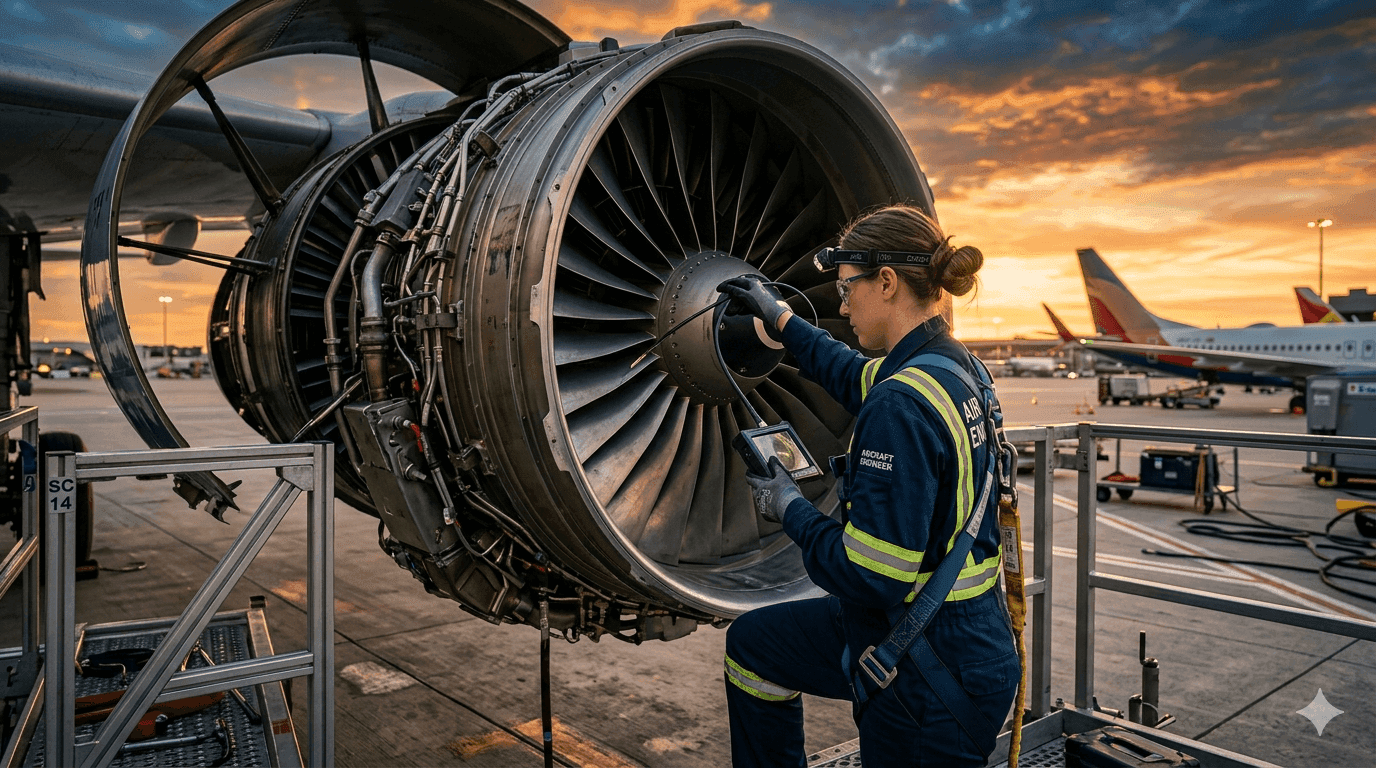


India's aviation sector is expanding at an unprecedented pace — new aircraft orders, greenfield airports, and MRO facilities are driving massive demand for skilled Aircraft Maintenance Engineers (AMEs). If you have a passion for engineering and a drive for precision, an AME career could be one of the most rewarding paths in Indian aviation.
AMEs are licensed professionals authorized by DGCA to certify aircraft airworthy for flight — a role that combines deep technical expertise with significant regulatory responsibility. This guide covers everything you need to know: eligibility, the DGCA licensing process, career growth, and salary benchmarks.
Need Personalised Guidance?
Choosing the right AME institute and understanding the DGCA licensing roadmap can be overwhelming. Book a free career consultation with our aviation experts before you commit.
1. What Does an Aircraft Maintenance Engineer Do?
An AME is the final authority responsible for certifying that an aircraft is safe to fly. Every commercial flight you board has been cleared by a licensed AME. Key responsibilities include:
• Conducting pre-flight and post-flight inspections
• Troubleshooting and rectifying technical defects
• Performing scheduled and unscheduled maintenance tasks
• Ensuring compliance with approved Maintenance Manuals and STCs
• Issuing a Certificate of Release to Service (CRS) — the AME's formal sign-off
An AME's signature on the Certificate of Release to Service carries full legal accountability — it is one of the most consequential certifications in aviation.
2. Regulatory Authority & Licensing Framework
AME licensing in India is governed by:
• DGCA (Directorate General of Civil Aviation) — issues and regulates AME licenses under CAR-66 regulations
• ICAO (International Civil Aviation Organization) — sets international airworthiness standards that DGCA aligns with
AME License Categories under CAR-66:
• Category A — Line maintenance certifying staff
• Category B1 — Maintenance certifying staff for mechanical systems
• B1.1 — Turbine Aeroplanes
• B1.2 — Piston Aeroplanes
• B1.3 — Turbine Helicopters
• B1.4 — Piston Helicopters
• Category B2 — Maintenance certifying staff for Avionics systems
3. Eligibility Criteria
To apply for AME training approved by DGCA, you must meet the following criteria:
• Education: 10+2 (Class XII) with Physics, Chemistry, and Mathematics (PCM) from a recognised board
• Minimum Age: 16 years at time of admission
• Medical Fitness: Physically and medically fit as per DGCA standards
• Language: English language proficiency is mandatory for all DGCA examinations and technical documentation
📖 How to Become a Pilot in India — Complete Step-by-Step Guide
📖 DGCA CPL Exam Pattern & Syllabus 2026
4. AME Training Program
AME training in India is a structured 4-year program comprising two phases:
• Phase 1 — Academic Training (2 years): Conducted at a DGCA-approved AME institute covering theoretical modules
• Phase 2 — On-the-Job Training / OJT (2 years): Practical hands-on experience at an approved aircraft maintenance organisation or airline
Core subjects covered during academic training:
• Aerodynamics and aircraft systems
• Avionics and electrical systems
• Maintenance practices and procedures
• Regulatory compliance and technical documentation
• Human factors in aviation maintenance
Estimated Training Cost: ₹3–6 lakhs depending on the institute, category chosen, and location.
📖 Career Roadmap for the Aspiring Commercial Pilot
📖 Pilot Salary in India 2026: Complete Guide
5. DGCA Examination Modules
To obtain an AME license, candidates must clear all mandatory DGCA module examinations. The exam modules are:
• Module 1 — Mathematics & Physics
• Module 2 — Electrical Fundamentals
• Module 3 — Electronic Fundamentals
• Module 4 — Digital Techniques / Electronic Instrument Systems
• Module 5 — Digital Techniques and Electronic Instrument Systems
• Module 6 — Materials and Hardware
• Module 7 — Maintenance Practices
• Module 8 — Basic Aerodynamics
• Module 9 — Human Factors
• Module 10 — Aviation Legislation
• Category-specific technical modules (e.g., Gas Turbine Engines for B1.1)
Note: Examinations are conducted by DGCA at designated test centres. Passing all modules is a prerequisite for license issuance.
6. Step-by-Step: How to Get Your DGCA AME License
Here is the complete AME licensing pathway:
1. Enrol in a DGCA-Approved AME Training Institute — Choose a recognised institute offering your preferred category (B1.1 is most popular for aspiring commercial aviation engineers).
2. Complete 2 Years of Academic Training — Attend lectures, labs, and workshop sessions covering all mandatory DGCA modules.
3. Clear All DGCA Module Examinations — Appear for and pass each of the 10+ DGCA theory modules.
4. Complete 2 Years of OJT — Accumulate the required hands-on maintenance experience at a DGCA-approved AMO or airline MRO.
5. Apply for AME License from DGCA — Submit your examination pass certificates, OJT logbook, and application documents to the DGCA licensing office.
6. Obtain Aircraft Type Rating — After receiving your basic AME license, complete type training on the specific aircraft type (e.g., Boeing 737, Airbus A320) to become authorised to sign CRS for that type.
Type Rating is a critical step many students overlook — without it, a licensed AME cannot issue a Certificate of Release to Service on any specific aircraft type. Airlines typically sponsor type training for their engineers.
7. Career Opportunities After AME Licensing
A DGCA AME license opens doors across the entire aviation ecosystem:
• Commercial Airlines — IndiGo, Air India, SpiceJet, Akasa Air, Vistara and more
• MRO Organisations — Air India Engineering Services, IndiGo Engineering, Air Works, Lufthansa Technik
• Aircraft Manufacturers & OEMs — HAL (Hindustan Aeronautics Limited), Boeing, Airbus facilities in India
• Flying Training Organisations (FTOs) — Maintaining training aircraft fleets
• Government & Defence Aviation — Indian Air Force, Navy, Coast Guard civilian technical roles
• International Opportunities — EASA and FAA license conversion paths for Middle East, Europe, and US employment
India's rapidly growing aviation sector — projected to become the world's 3rd largest by 2030 — means demand for licensed AMEs will continue to outpace supply for the foreseeable future.
8. Career Growth Path & Salary Overview
AME careers follow a well-defined progression ladder with strong salary growth at each stage:
| Stage | Role | Approx. Salary |
| 1 | Trainee Technician | ₹15,000 – ₹30,000/month |
| 2 | Aircraft Technician | ₹30,000 – ₹60,000/month |
| 3 | Licensed AME | ₹1,00,000 – ₹3,00,000+/month |
| 4 | Senior AME | Competitive + allowances |
| 5 | Lead / Supervisor AME | Senior pay scale |
| 6 | Maintenance / Quality Manager | Management-level CTC |
Note: Salaries vary significantly based on employer (airline vs MRO vs defence), city, and the type of aircraft you are type-rated on. Wide-body aircraft type ratings (B777, A380) command premium pay.
9. AME Career at a Glance
| Factor | Details |
| Career Path | Aircraft Maintenance Engineer (AME) |
| Minimum Education | 10+2 with Physics, Chemistry & Mathematics |
| Minimum Age | 16 years |
| Training Duration | 2 years academic + 2 years OJT (total ~4 years) |
| Estimated Training Cost | ₹3–6 lakhs (varies by institute) |
| License Authority | DGCA India (CAR-66) |
| Starting Salary (Trainee) | ₹15,000 – ₹30,000/month |
| Licensed AME Salary | ₹1,00,000 – ₹3,00,000+/month |
| Top Employers | IndiGo, Air India, SpiceJet, HAL, MRO companies |
| Key Requirement | DGCA module exams + OJT + Type Rating |
10. Advantages and Challenges of an AME Career
Advantages:
• High-responsibility, deeply respected technical profession within the aviation industry
• Global employment opportunities — AME licenses have international conversion pathways (EASA, FAA)
• Strong job security driven by mandatory regulatory requirements for aircraft maintenance
• Advanced technical skill development across mechanical, avionics, and systems engineering
• More cost-accessible than CPL training — total investment of ₹3–6 lakhs vs ₹25–45 lakhs for pilot training
Challenges:
• High accountability — errors in maintenance can have severe safety consequences
• Continuous learning required to keep pace with evolving aircraft technology (composites, fly-by-wire, avionics)
• Demanding and often irregular work hours, including night shifts and AOG (Aircraft on Ground) responses
• Strict regulatory compliance required at all times — non-compliance risks license suspension
Not Sure Whether AME Is the Right Career for You?
Choosing between AME, CPL, cabin crew, or airport management depends on your interests, educational background, and long-term goals. Our aviation career counsellors offer free, personalised guidance — no cost, no commitment.
👉 Get Free Career Consultation — Speak to an Apano Aviation Expert
What to Do Next
If AME is the right path for you, here's how to get started:
7. Confirm your eligibility — ensure you have PCM in 10+2 and are at least 16 years old
8. Explore DGCA-approved institutes on Apano Aviation — compare fees, category offered, and batch start dates
9. Book a free consultation to get personalised advice on institute selection and DGCA module preparation
10. Apply to your chosen AME training institute and begin your aviation engineering journey
Your aviation engineering career starts with one decision — and we're here to make sure it's the right one.
📖 How to Clear DGCA Exams in First Attempt
📖 How to Become a Pilot in India — Complete Step-by-Step Guide