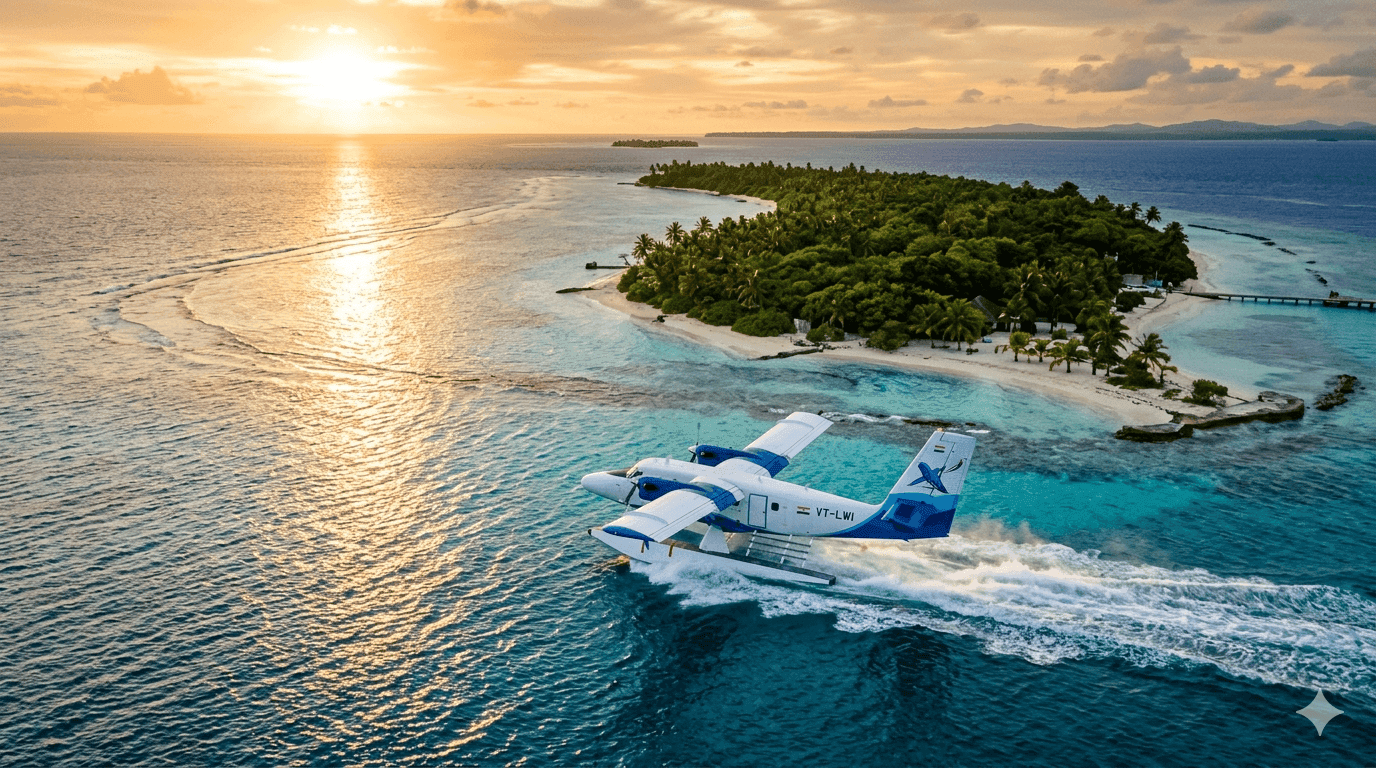


India's aviation sector has reached a historic milestone. The Directorate General of Civil Aviation (DGCA) has granted an Air Operator Certificate (AOC) to SkyHop Aviation, officially clearing the path for India's first dedicated commercial seaplane airline. Operations are set to commence in the Lakshadweep islands — a move that signals a transformative shift in how remote and island regions of India will be connected to the mainland.
This is not just a win for aviation enthusiasts — it is a breakthrough for regional tourism, island economies, and the millions of Indians who have long been underserved by conventional air transport infrastructure.
Interested in a career in Indian aviation? Whether you want to fly, maintain aircraft, or work in airport operations — explore India's top aviation institutes on Apano. Browse Aviation Institutes →
What Is a Seaplane and How Does It Work?
Seaplanes are specialised aircraft designed to take off and land on water. Unlike conventional commercial aircraft that depend on runways and airport infrastructure, seaplanes operate directly from water aerodromes — lakes, rivers, coastlines, and island lagoons.
This unique capability makes them exceptionally suited for:
- Island territories with no room for conventional runways
- Coastal regions where water access is faster than road travel
- Remote inland destinations such as large lakes and reservoirs
- Tourism circuits that link scenic waterfront locations
There are two primary types:
- Flying boats – the hull of the aircraft itself sits on water
- Amphibious aircraft – equipped with both floats and retractable landing gear, allowing operations from both water and conventional runways
SkyHop Aviation is expected to operate amphibious aircraft, giving it the flexibility to connect island waterfronts with mainland airports in a single route.
DGCA's AOC Approval – Why It Matters
The Air Operator Certificate (AOC) is the highest level of regulatory clearance an airline can receive in India. Issued by DGCA, it certifies that an operator has fully met all requirements under the Civil Aviation Requirements (CAR) — covering:
- Aircraft airworthiness and maintenance standards
- Crew training and licensing — including seaplane-specific endorsements
- Safety management systems (SMS)
- Operational readiness across all planned routes
- Emergency and evacuation procedures for water operations
Receiving an AOC is a rigorous, multi-stage process that typically takes 18–36 months. SkyHop Aviation's approval signals that India now has a commercially ready, fully compliant seaplane operator for the first time in the country's aviation history.
Why Lakshadweep Was Chosen for Launch
Lakshadweep — India's smallest Union Territory — is an archipelago of 36 coral islands located approximately 200–440 km off the Kerala coast in the Arabian Sea. Despite its natural beauty and growing tourism interest, the region has historically suffered from severe connectivity challenges:
- Only one airport (Agatti Island) serves the entire 36-island archipelago
- Inter-island travel depends on slow ferry services that can take 14–20 hours
- Poor connectivity has historically limited tourism growth and economic activity
Seaplane services offer a direct solution. A seaplane can connect multiple Lakshadweep islands — Kavaratti, Minicoy, Bangaram, Kadmat — to each other and to the Kerala mainland in under 60–90 minutes, compared to overnight ferry journeys.
The launch of SkyHop Aviation's services in Lakshadweep is expected to:
- Dramatically cut inter-island travel time
- Open up previously inaccessible islands for tourism
- Reduce dependence on slow, weather-dependent ferry services
- Support government and military logistics in the region
Seaplane vs Ferry vs Helicopter: Lakshadweep Connectivity Compared
| Mode | Travel Time | Approx. Cost | Capacity | Weather Dependency |
|---|---|---|---|---|
| Seaplane (SkyHop) | 60–90 minutes | ₹3,000–₹8,000 (est.) | Up to 19 passengers | Moderate |
| Ferry | 14–20 hours | ₹500–₹2,000 | 100–500 passengers | High |
| Helicopter (existing) | 90–120 minutes | ₹3,500–₹6,000 | 6–12 passengers | Moderate |
| Fixed-wing (Agatti only) | 90 minutes from Kochi | ₹5,000–₹12,000 | 40–70 passengers | Low |
Seaplane fares are estimates based on UDAN-supported pricing frameworks and have not been officially announced by SkyHop Aviation.
How Much Does a Seaplane Ticket Cost in India?
Official fares from SkyHop Aviation have not yet been released. However, based on the UDAN 4.0 framework's viability gap funding (VGF) support and international seaplane pricing benchmarks (the Maldives, Norway, Canada), island-hop fares are expected to be positioned as a premium but accessible option — likely in the ₹3,000–₹8,000 range per seat for short routes.
UDAN's pricing mandate typically caps fares on subsidised routes, which may make short Lakshadweep hops competitive with helicopter options currently available. Longer routes (island to Kerala mainland) would naturally carry a higher price point.
Seaplane vs Ferry: How Much Time Does It Actually Save?
The answer depends on the origin-destination pair, but the savings are dramatic:
- Kochi → Kavaratti by ferry: ~18 hours. By seaplane: ~60–75 minutes.
- Agatti → Kavaratti by ferry: ~3–5 hours. By seaplane: ~15–20 minutes.
- Kavaratti → Minicoy by ferry: ~14 hours. By seaplane: ~45–60 minutes.
For tourists looking to visit multiple islands in a single trip, the seaplane effectively unlocks a Lakshadweep island-hopping experience that simply wasn't viable before — comparable to what seaplanes have done for Maldivian tourism over the past three decades.
Boost to Tourism and the Local Economy
Lakshadweep's pristine coral reefs, lagoons, and beaches hold enormous tourism potential — yet the region receives only a fraction of the visitors that the Maldives attracts annually, largely due to connectivity barriers.
Seaplane services are expected to change this equation significantly:
For tourists:
- Faster, more scenic access to multiple islands in a single trip
- Premium experience that enhances India's appeal as an island destination
- New tourism circuits connecting Kerala backwaters to Lakshadweep islands
For the local economy:
- Direct employment in ground handling, water aerodrome operations, and hospitality
- Indirect growth in hotels, restaurants, water sports, and local crafts
- Increased tax revenue for the Union Territory administration
India's tourism ministry has identified seaplane connectivity as a key pillar in promoting Lakshadweep as a world-class destination — a direct response to growing international interest following the 2024 Maldives tourism controversy, when India actively promoted domestic island tourism.
Aircraft and Technology Behind the Operation
SkyHop Aviation is widely expected to operate the De Havilland Canada DHC-6 Twin Otter — one of the world's most proven and trusted seaplane and STOL (Short Takeoff and Landing) aircraft.
Key specs of the DHC-6 Twin Otter:
| Feature | Details |
|---|---|
| Passenger capacity | Up to 19 passengers |
| Engine type | Twin turboprop |
| Range | ~1,300 km |
| Operating surface | Water and conventional runways (amphibious variant) |
| Reliability | Proven in 100+ countries |
The Twin Otter's reputation for reliability in challenging environments — from Maldivian atolls to Alaskan coastal routes — makes it the ideal choice for India's island and coastal seaplane operations.
Alignment with UDAN and Government Connectivity Schemes
The launch of India's first commercial seaplane airline directly aligns with the UDAN (Ude Desh ka Aam Naagrik) scheme — the Government of India's flagship regional connectivity initiative launched in 2016.
UDAN's core objective is to make air travel affordable and accessible to common citizens in underserved regions. Seaplane routes fall under UDAN 4.0, which specifically introduced water aerodrome routes to the scheme for the first time, offering:
- Viability gap funding (VGF) support for operators on unviable but essential routes
- Route exclusivity for a defined period to encourage new operators
- Infrastructure support for the development of water aerodromes
SkyHop Aviation's AOC positions it as a key player in UDAN's water aerodrome expansion — with potential to bid for subsidised routes connecting coastal and island destinations across India.
Challenges and Considerations
While the milestone is historic, seaplane operations in India come with a unique set of challenges that must be addressed for long-term viability:
1. Environmental Sensitivity Lakshadweep's coral ecosystems are fragile. Seaplane operations must follow strict environmental protocols to prevent fuel spillage, water turbulence damage to reefs, and noise pollution affecting marine life.
2. Water Aerodrome Infrastructure India currently has very limited water aerodrome infrastructure. Jetties, passenger terminals, fuelling systems, and emergency equipment need to be developed at each operating point.
3. Weather Dependency Seaplanes are significantly more weather-sensitive than conventional aircraft. Monsoon seasons, rough seas, and strong crosswinds can ground operations for extended periods — a critical consideration in island regions.
4. Past Failures as a Reference Point India has seen previous seaplane attempts — including the Gujarat government's Sabarmati River seaplane project and Kerala's backwater seaplane pilot — face operational and financial challenges. SkyHop Aviation must learn from these experiences to build a sustainable model.
5. Regulatory Complexity Water aerodrome operations involve multiple regulatory bodies — DGCA, the Ministry of Ports and Shipping, state maritime boards, and environment ministries — requiring careful inter-agency coordination.
A New Chapter for Indian Aviation — and Aviation Careers
SkyHop Aviation's AOC approval is more than an airline launch — it represents the integration of air and water transport into a unified mobility ecosystem for the first time in India.
For aviation professionals and students, this development signals new career pathways:
- Seaplane-rated commercial pilots — a niche and highly valued skillset globally
- Water aerodrome operations management
- Marine aviation safety and compliance roles
- Ground handling and passenger services at water aerodromes
DGCA is expected to publish updated licensing requirements for seaplane ratings under the CPL framework, creating new training opportunities for Indian flying schools and FTOs.
Ready to start your pilot training journey? Explore DGCA-approved flying schools across India — compare courses, fees, and placements all in one place. Find FTO Flying Schools on Apano →
Future Prospects – Where Could Seaplanes Go Next?
If SkyHop Aviation's Lakshadweep launch is successful, the expansion roadmap for seaplane services in India is vast:
Near-term expansion targets:
- Andaman & Nicobar Islands – connecting Port Blair with remote island clusters
- Kerala Backwaters – linking Kochi, Alleppey, Kumarakom, and Kovalam
- Goa Coastal Circuit – scenic routes between Panjim and beach destinations
Medium-term potential:
- Inland waterways – rivers and reservoirs in Madhya Pradesh, Odisha, and the Northeast
- Himalayan lakes – Dal Lake (Srinagar), Naini Lake (Nainital)
- Major dam reservoirs – Sardar Sarovar, Bhakra Nangal
Long-term vision:
- India becoming a regional hub for seaplane manufacturing and pilot training
- Export of seaplane operational expertise to South Asian and Southeast Asian markets
Conclusion
The DGCA's decision to grant an AOC to SkyHop Aviation marks a defining moment in Indian aviation history. After decades of unfulfilled promises and short-lived experiments, India finally has a commercially certified, regulation-compliant seaplane airline ready to take to the waters.
For Lakshadweep, this means faster connections, growing tourism, and economic opportunities that were previously out of reach. For India's aviation sector, it opens an entirely new chapter — one that blends the skies with the sea, and connects the corners of the country that conventional aviation simply cannot reach.
The future of Indian aviation isn't just in the skies. It's on the water too.
Related Articles
- India's FTOs Issue 2,309 Student Pilot Licences in 2025
- DGCA CPL Exam Pattern & Syllabus 2026
- DGCA Exam Schedule 2026: All Important Dates
This article is based on publicly available information from DGCA and the Ministry of Civil Aviation, Government of India. For the latest updates on seaplane route approvals and AOC notifications, refer to the official DGCA website at dgca.gov.in.