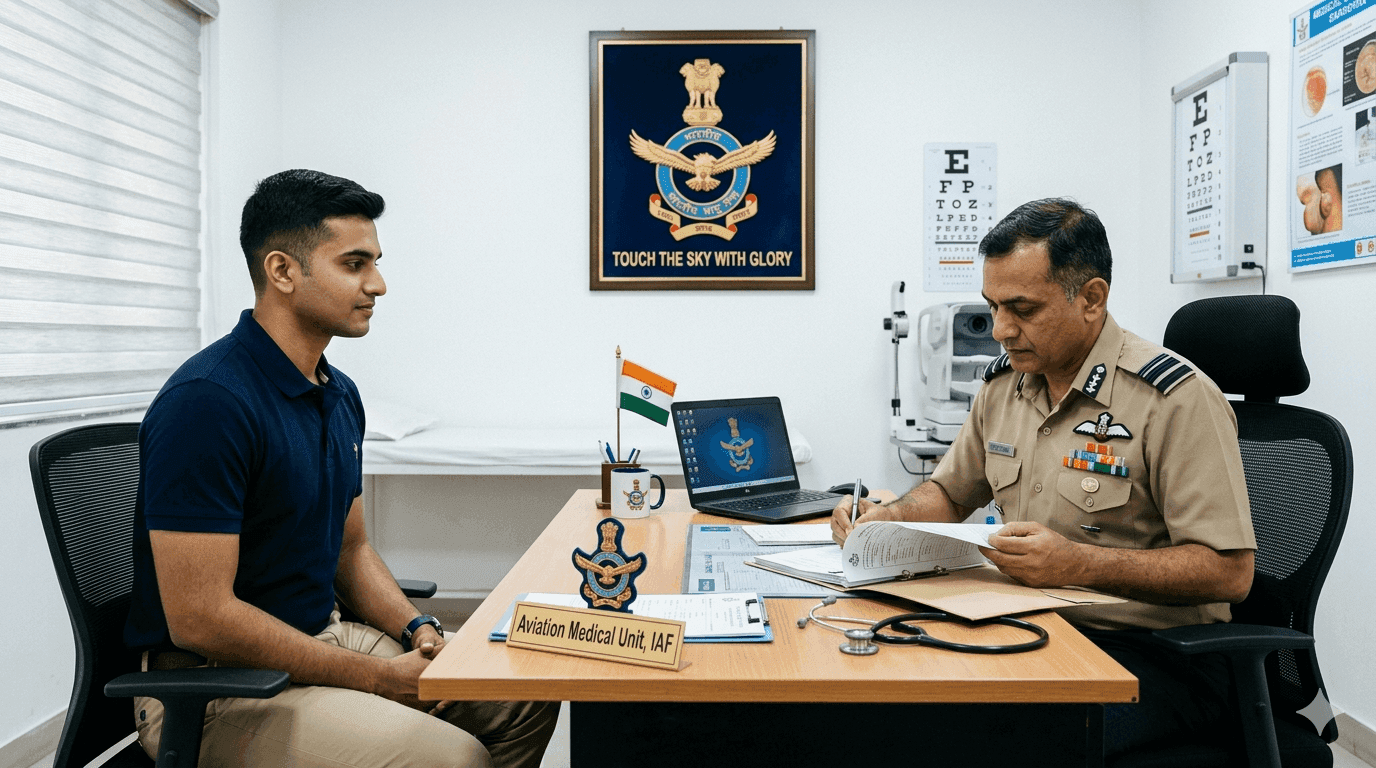


In India, pilot medical certification is governed by the Directorate General of Civil Aviation (DGCA). The standard pathway requires candidates to obtain a Class 2 Medical Certificate before progressing to a Class 1 Medical — but there is a well-defined route that lets eligible candidates skip this step entirely.
Under specific conditions, CPL and ATPL aspirants can apply directly for a Class 1 Medical Certificate through a Medical NOC (No Objection Certificate) and undergo examination at Indian Air Force (IAF) Boarding Centres. This guide covers everything you need to know about this pathway — eligibility, process, documentation, advantages, and what to watch out for.
📞 Not Sure Which Medical Route to Take?
Book a free consultation with our aviation experts. We'll help you evaluate your profile and choose the right medical pathway for your CPL journey.
1. What is a Medical NOC?
A Medical NOC (No Objection Certificate) is an official approval issued by the DGCA that permits a candidate to undergo a pilot medical examination when the standard sequential process cannot be followed — or when the candidate qualifies for a direct pathway.
Key Points:
- Applicable for Class 1, Class 2, and Class 3 medical examinations
- Enables examinations at DGCA empanelled examiners or IAF Boarding Centres
- Mandatory for special or exceptional cases where the standard process cannot be followed
- Issued on a case-by-case basis by DGCA after reviewing the candidate's application
"The Medical NOC system is DGCA's mechanism to ensure that genuine aspirants are not unfairly blocked by procedural sequences. If you are medically fit, this route can save you significant time and expense."
2. When Can You Skip Class 2?
Not every candidate qualifies to bypass Class 2. The NOC route is applicable in specific, well-defined scenarios:
A. Direct Class 1 via IAF Boarding Centres
- Apply for an Initial or Re-initial Class 1 medical examination
- Select an IAF Boarding Centre as the examination venue in your NOC application
- This is the most common pathway used by CPL and ATPL aspirants who want to enter the licensing process efficiently
B. Special Cases Where NOC Is Required
- Previously declared Temporarily Unfit (TU): If you were earlier declared unfit and wish to re-attempt
- Medical certificate expired beyond 2 years: Routine renewal channels are no longer applicable
- Special medical review required: Cases involving borderline health conditions that need senior DGCA or specialist evaluation
📖 DGCA CPL Exam Pattern and Syllabus 2026
3. Preconditions Before You Apply
Before submitting your Medical NOC application on the eGCA portal, ensure the following are in order:
Eligibility Checklist
- Valid eGCA ID (your registered account on the DGCA eGCA portal)
- Updated and complete medical records
- A valid, documentable reason for requiring the NOC
- Confirmed appointment with the examiner or IAF Boarding Centre
⚠️ Important Note: Candidates who have been declared Permanently Unfit are not eligible to apply for a Medical NOC under any circumstances. There is no appeal route through the NOC system for permanent unfit declarations.
Required Documents
- Previous medical assessment report (if any prior medical examination was conducted)
- Unfit letter from DGCA or examiner (if applicable)
- Appointment confirmation from the examiner or IAF Boarding Centre
4. Application Process — eGCA Portal
The Medical NOC application is processed entirely through the DGCA eGCA portal. The process is structured in eight steps:
- Login to the DGCA eGCA portal using your registered credentials
- Select Service: Navigate to and click on Request for Medical NOC
- Select Medical Class: Choose Class 1 Medical from the available options
- Fill Application: Select your NOC Type (Early / Delayed / Special), Service Type (Initial / Re-initial / Renewal), and upload all required supporting documents
- Select Examination Centre: Choose your preferred IAF Boarding Centre and specific Air Force hospital from the available list
- Payment: Complete payment through the BharatKosh government payment gateway, then select your examination date and time slot
- DGCA Processing: Your application will show one of four statuses — Pending, Approved, Returned (for corrections), or Rejected
- Medical Application Submission: Once approved, submit your medical examination form and complete mandatory re-validation on the examination date
"Re-validation on the day of your medical examination is compulsory. Your NOC is valid for one examination date only — if you miss it for any reason, you will need to restart the application process from the beginning."
5. Critical Rules to Follow
The NOC process has strict rules. Non-compliance will invalidate your application:
- NOC validity: Each NOC is valid for one examination date only — no extensions are granted
- Missed examination: If you miss your scheduled date, you must reapply from scratch
- No changes after submission: Once submitted, the application cannot be modified — review everything carefully before submitting
- Medical form submission: Your medical application form must be submitted before the examination date
- Re-validation is mandatory: You must complete re-validation on the day of your examination at the IAF centre — this step cannot be skipped
📖 How to Become a Commercial Pilot in India — Complete Guide
6. Advantages of the Medical NOC Route
Choosing the NOC pathway for a direct Class 1 medical has several meaningful benefits for CPL aspirants:
- Time efficiency: You skip the Class 2 examination entirely, reducing the total time to obtain your Class 1 certificate
- Direct CPL pathway: A valid Class 1 medical is required for the CPL licence — this route gets you there faster
- IAF medical facilities: IAF Boarding Centres are equipped with high-standard diagnostic infrastructure and experienced aviation medical officers
- Faster overall progression: Fewer sequential steps mean you can move through the DGCA licensing process more quickly
- Single examination: You undergo one comprehensive Class 1 medical rather than two separate examinations
7. Limitations and Risks
The NOC route is efficient, but it carries real risks that candidates must understand before applying:
- Strict Class 1 standards: The Class 1 medical is significantly more rigorous than Class 2. There is less margin for borderline health conditions
- Risk of Unfit declaration: If you are declared unfit at Class 1 level, this can complicate your overall licensing prospects more seriously than an earlier Class 2 failure would have
- Limited IAF examination slots: IAF Boarding Centres have restricted appointment availability — especially for civilian candidates. Scheduling can be challenging
- Documentation requirements: The NOC process demands complete and accurate documentation. Incomplete applications will be returned or rejected
- No modification after submission: Any error in your application requires a full restart — there is no partial correction mechanism
"If you have any doubt about your medical fitness at Class 1 standard, take the Class 2 examination first. The Class 2 route gives you an earlier indication of your fitness profile with lower stakes."
📞 Not Sure Which Route Suits You?
Our aviation counsellors can review your health profile, examination history, and CPL goals to help you make the right decision — Class 2 first, or direct Class 1 via the NOC route.
Quick Comparison: Direct Class 1 (NOC Route) vs Standard Class 2 → Class 1
| Factor | Direct Class 1 (NOC Route) | Class 2 → Class 1 Route |
|---|---|---|
| DGCA Class 2 Required | No | Yes |
| Medical Centre | IAF Boarding Centre | DGCA Empanelled Examiner |
| Standard | Class 1 (Strict) | Class 2, then Class 1 |
| Best For | Fit, confident CPL aspirants | First-time or unsure candidates |
| Risk of Unfit | Higher (strict standards) | Lower initial risk |
| Processing | NOC → IAF exam | Sequential exams |
| Slot Availability | Limited (IAF) | More flexible |
9. Which Route Should You Choose?
The right choice depends on your individual medical profile and risk appetite:
Choose the Direct Class 1 NOC Route if:
- You are confident in your medical fitness and have no known borderline conditions
- You have had a prior Class 2 medical with no issues and want to progress to Class 1 directly
- You want to minimise total time and cost in the DGCA licensing process
- Your examination records and documentation are complete
Choose the Standard Class 2 → Class 1 Route if:
- You are undergoing your first-ever DGCA medical examination and have uncertainty about your fitness
- You have a borderline health condition (vision, blood pressure, ENT) that you want assessed at a lower-stakes level first
- IAF Boarding Centre slots are not available in your preferred time window
- You prefer the sequential route for better preparation and certainty
📖 DGCA CPL Exam Study Materials and Guides
10. What to Do Next
- Confirm your eligibility — check the preconditions listed in Section 3 above
- Gather your documents — previous medical records, unfit letters (if applicable), appointment confirmation
- Register or log in to the DGCA eGCA portal and navigate to Medical NOC applications
- Book your IAF Boarding Centre slot early — availability is limited
- Submit your application carefully — verify all details before submitting, as changes cannot be made afterwards
- Book a free consultation with our aviation experts if you have any doubt about your route or documentation
📞 Get Expert Guidance on Your DGCA Medical Journey
The Medical NOC process has strict rules, limited slots, and no room for error. Let our aviation counsellors walk you through it — step by step, at no cost.
Your pilot career starts with one decision — and the medical route you choose sets the foundation for everything that follows. Plan carefully, document thoroughly, and reach out if you need guidance.
📖 How to Become a Pilot in India — Complete Guide 2026